Because Every Tooth Deserves Care.

Dental Implants for Pensioners in Iceland: Costs, Coverage, Financing and Treatment Guide
image hero:
Country:
Dental implants can provide a stable and highly functional replacement for missing teeth, but for pensioners in Iceland, the financial calculation is different from that of younger adults.
The most important point is that Iceland Health does provide dental participation for pensioners. The rules are more generous for general dental treatment and dentures than for a fixed implant replacing a tooth in a dentate jaw. Certain implant treatments can receive substantial participation, particularly implants used to support dentures in a completely edentulous jaw.
For that reason, a pensioner should obtain a written treatment plan and ask the dentist to calculate the expected Iceland Health contribution before starting treatment.
1. Who Qualifies as a Pensioner for Dental Coverage?
For Iceland Health dental purposes, pensioners include:
-
People aged 67 or older
-
Individuals with more than 75% disability
Iceland Health states that pensioners receive 75% participation in general dental repairs, subject to the applicable rules and limitations. General dentistry includes examinations, diagnosis, X-rays, routine dental procedures, root-canal treatment, periodontal treatment and tooth extraction.
This does not mean that Iceland Health simply pays 75% of every dental implant.
Implant reimbursement depends on whether the patient has natural teeth remaining, whether the implant is supporting a denture, the location of the treatment and whether prior approval is required.
2. Average Dental Implant Cost for Pensioners in Iceland
A complete single-tooth implant can represent a substantial private expense.
For planning purposes, a pensioner may encounter a total treatment cost in the approximate range of:
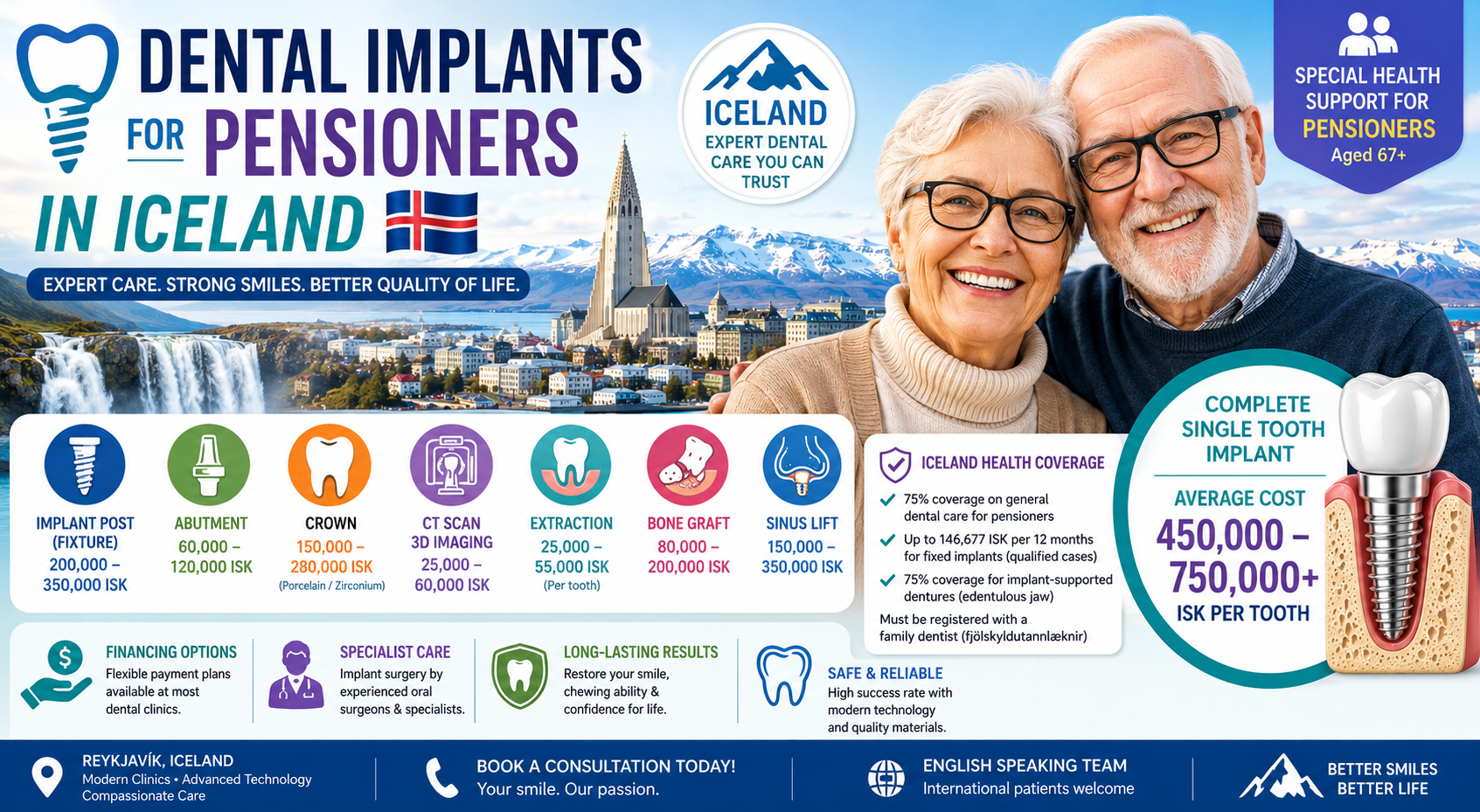
ISK 450,000–750,000+
However, this should not be treated as an official Iceland-wide average.
Actual prices vary substantially according to:
-
Implant manufacturer
-
Implant surgeon
-
Crown material
-
Dental laboratory
-
Imaging
-
Extraction
-
Bone quality
-
Bone grafting
-
Sinus augmentation
-
Temporary teeth
-
Specialist involvement
-
Complexity of the case
Current Icelandic clinic pricing demonstrates considerable variation. For example, Tannlæknastofan Turninn lists an implant crown/crown on an implant at ISK 230,000, while another Icelandic provider publishes separate prices for implant components, abutments and crowns.
Therefore, a pensioner should compare complete treatment plans, rather than comparing advertisements for the implant fixture alone.
3. Cost by Implant Type
| Treatment | Indicative planning range |
|---|---|
| Single implant restoration | ISK 450,000–750,000+ |
| Multiple individual implants | ISK 700,000–1,500,000+ |
| Implant-supported removable denture | Highly variable |
| Full upper/lower implant denture | Several hundred thousand ISK and upward |
| Fixed full-arch implant restoration | Often ISK 1,000,000+ |
| Complex full-mouth reconstruction | Can exceed several million ISK |
These are planning ranges, not official Iceland Health reimbursement tariffs.
A pensioner's final out-of-pocket cost can be significantly lower when Iceland Health participation applies.
4. Implant + Abutment + Crown
A complete single-tooth implant normally consists of three principal components:
Implant fixture
The titanium implant is placed into the jawbone and acts as the artificial tooth root.
Abutment
The abutment connects the implant to the final crown.
Crown
The crown provides the visible tooth structure and restores chewing function and appearance.
One Icelandic clinic currently lists a plant crown/crown on an implant at ISK 230,000, while another Icelandic price list shows separate abutment and crown pricing.
The critical question
When a clinic quotes an implant price, ask:
"Does this price include the implant fixture, surgery, abutment, crown and laboratory work?"
If not, the advertised price may be considerably lower than the actual cost of the finished tooth.
5. CT Scan / CBCT Cost
Three-dimensional CBCT imaging may be recommended before implant surgery.
It allows the dentist or surgeon to evaluate:
-
Bone width
-
Bone height
-
Nerve location
-
Sinus anatomy
-
Adjacent roots
-
Previous bone loss
-
Implant positioning
Published Icelandic pricing examples show CT/CBCT charges around ISK 24,000–35,000, although the actual price depends on the examination and provider.
Iceland Health also maintains a specific fee schedule for imaging examinations and rules concerning participation in CBCT examinations.
A pensioner should therefore ask whether the CBCT is included in the implant package and whether any Iceland Health participation applies.
6. Tooth Extraction Cost
Extraction may be necessary when a tooth is:
-
Fractured
-
Severely decayed
-
Periodontally hopeless
-
Infected
-
Structurally unsuitable for restoration
A current Icelandic dental price list shows simple extraction in the approximate range of ISK 30,000–39,000.
Surgical extraction can cost substantially more.
The final price depends on:
-
Tooth location
-
Root anatomy
-
Bone coverage
-
Infection
-
Surgical difficulty
-
Specialist involvement
For a pensioner eligible for Iceland Health participation, ordinary tooth extraction falls within general dentistry, for which Iceland Health states it pays 75% for pensioners, subject to the applicable rules.
7. Bone Graft Cost
Bone loss is common after long-term tooth loss and may become more pronounced with periodontal disease.
A bone graft may be necessary before implant placement when there is insufficient bone volume.
Potential procedures include:
-
Socket preservation
-
Ridge augmentation
-
Guided bone regeneration
-
Larger bone reconstruction
Published Icelandic price information demonstrates that bone augmentation can become a significant additional expense. One Icelandic clinic's price list, for example, lists bone grafting and membrane procedures separately.
Planning range
A reasonable budgeting range is approximately:
ISK 80,000–250,000+
The actual cost depends heavily on the amount of graft material, membrane use and surgical complexity.
8. Sinus Lift Cost
A sinus lift may be necessary for an implant in the upper back jaw when there is insufficient bone between the jaw ridge and maxillary sinus.
Two broad approaches are commonly discussed:
-
Closed sinus elevation
-
Open/lateral-window sinus augmentation
The procedure can add a substantial amount to the treatment budget.
Planning range
Approximately ISK 150,000–350,000+
The exact price should identify whether it includes:
-
Surgical fee
-
Graft material
-
Membrane
-
CBCT
-
Follow-up appointments
-
Implant placement
A sinus lift is not automatically necessary simply because an upper molar is missing. The decision should be based on clinical examination and three-dimensional imaging.
9. Insurance Coverage: What Iceland Health Actually Pays
This is the most important section for pensioners.
General dental treatment
Iceland Health states that pensioners receive 75% participation in general dental repairs, subject to the applicable agreement and limitations. General treatment includes examinations, diagnosis, X-rays, dental procedures, root canals, periodontics and extractions.
Dentures
For pensioners, Iceland Health pays 75% of the dentist and dental technician costs for construction of dentures, including:
-
Full dentures
-
Implant dentures
-
Partial dentures
This participation is generally available every six years, with relining participation every three years under the applicable rules.
Fixed implants in a dentate jaw
This is different.
If the pensioner still has natural teeth in the upper or lower jaw, Iceland Health may provide a grant toward dental implants or other fixed prostheses in qualifying positions.
The current maximum is:
Up to ISK 146,677 per 12-month period
for qualifying fixed dental prostheses or implants located in front of the 12-year molars. The amount is based on the treatment date.
This is not the same as a 75% reimbursement of the entire implant.
Implants in a completely edentulous jaw
The rules can be much more favorable when the patient has no natural teeth in the jaw and implants are being placed to support dentures.
Iceland Health states that, with approval, it pays 75% of the pensioner's cost of inserting implants supporting dentures, with participation for the first:
-
2 implants in the lower jaw
-
4 implants in the upper jaw
The dentist must apply and receive approval before treatment begins.
Key lesson
A pensioner should never assume that "implants are not covered."
The correct question is:
"Which part of my specific implant treatment qualifies for Iceland Health participation?"
10. Prior Approval and Family Dentist
Iceland Health's current rules make the distinction between different implant situations particularly important.
For some implant treatments, prior approval is required.
Iceland Health has specifically stated that payment participation for implant treatment in a dentate jaw by elderly and disabled patients has been subject to an application procedure in certain circumstances.
Iceland's official information also states that registration with a family dentist is a prerequisite for pensioner dental participation.
Before expensive treatment begins, ask the dentist to verify:
-
Your pensioner status
-
Your family-dentist registration
-
The applicable Iceland Health category
-
The expected reimbursement
-
Whether prior approval is required
11. Financing Dental Implants for Pensioners
Even after Iceland Health participation, an implant can leave a significant personal balance.
Possible financing approaches include:
Clinic payment arrangements
Some dental clinics may allow staged payments corresponding to:
-
Examination
-
Surgery
-
Healing
-
Abutment
-
Crown
Pension or union benefits
Some pension funds, unions or organizations may offer additional health-related benefits. Eligibility varies, so the pensioner should check directly with the relevant organization.
Treatment abroad
Iceland Health allows pensioners to seek qualifying dental treatment in the EEA, United Kingdom and Switzerland and subsequently apply for participation under Icelandic rules. However, reimbursement is assessed under Icelandic rules and is not automatically based on the foreign clinic's price. Travel expenses are not reimbursed.
This means traveling abroad should never be viewed as simply:
"Foreign clinic price = amount I will pay."
The reimbursement calculation must be checked first.
12. Dentist vs. Specialist Costs
Implant treatment may involve several professionals.
General dentist
May handle:
-
Examination
-
Diagnosis
-
Extraction
-
Periodontal treatment
-
Prosthetic planning
-
Crown restoration
Implant dentist
May coordinate the entire implant process and restorative treatment.
Oral and maxillofacial surgeon
May be involved in:
-
Difficult extractions
-
Major bone grafting
-
Sinus surgery
-
Complex implant surgery
-
Nerve-related cases
-
Significant jaw reconstruction
Periodontist
May be involved when periodontal disease, gum recession or soft-tissue deficiencies complicate the case.
Specialist treatment generally costs more because it involves more complex diagnosis, equipment, training and surgical procedures.
13. Potential Complications in Older Implant Patients
Age alone does not automatically make someone a poor implant candidate.
The more important questions are:
-
Is the patient medically stable?
-
Is oral hygiene adequate?
-
Is there active periodontal disease?
-
Is there enough bone?
-
Are medications relevant to surgery?
-
Is smoking involved?
-
Can the patient maintain regular dental care?
Peri-implantitis
Inflammation around an implant can cause bone loss and potentially implant failure.
Failure of osseointegration
The implant may fail to integrate with bone and may need removal and replacement.
Infection
Postoperative infection requires professional assessment.
Nerve injury
Lower-jaw implants must be planned carefully around the inferior alveolar nerve.
Sinus complications
Upper-jaw surgery can affect the maxillary sinus.
Prosthetic complications
The crown or abutment can loosen, fracture or require replacement even when the implant remains integrated.
14. Implant vs. Bridge
| Feature | Implant | Traditional Bridge |
|---|---|---|
| Surgery | Usually required | Usually not |
| Adjacent teeth | Usually preserved | Usually prepared |
| Bone stimulation | Yes | No |
| Treatment time | Longer | Usually shorter |
| Initial cost | Higher | Often lower |
| Cleaning | Implant-specific hygiene | Cleaning underneath bridge required |
| Longevity | Potentially very long-lasting | Often requires replacement over time |
For a pensioner with healthy neighboring teeth, an implant may avoid cutting those teeth.
However, if the neighboring teeth already need crowns, a bridge may be clinically reasonable.
The correct treatment is determined by the individual dental situation.
15. Implant vs. Dentures
For several missing teeth, pensioners should compare implants with removable dentures.
Conventional dentures
Advantages:
-
Lower initial treatment complexity
-
No implant surgery
-
Can replace many missing teeth
-
Iceland Health provides substantial participation for qualifying pensioners
Disadvantages:
-
Can move during chewing
-
May require relining
-
May cause sore areas
-
Does not replace individual tooth roots
Implant-supported dentures
Advantages:
-
Better retention
-
Improved chewing stability
-
Less movement
-
Can be particularly useful when conventional dentures are unstable
Disadvantages:
-
Requires surgery
-
Higher treatment complexity
-
Requires sufficient bone or additional surgery
-
Maintenance remains necessary
For some pensioners, an implant-supported denture can be an excellent middle ground between a conventional removable denture and a completely fixed full-arch reconstruction.
16. Questions to Ask Your Dentist
Before approving treatment, ask these questions:
-
Am I medically and dentally suitable for an implant?
-
Can my natural tooth still be saved?
-
How much bone do I have?
-
Do I need a bone graft?
-
Do I need a sinus lift?
-
Is a CBCT scan required?
-
Which implant system are you recommending?
-
What is the complete cost from surgery to final crown?
-
Does the quotation include the abutment?
-
Does it include the laboratory crown?
-
What part qualifies for Iceland Health participation?
-
Do I need prior approval?
-
Am I registered with a family dentist?
-
Would a bridge be more appropriate?
-
Would an implant-supported denture be more cost-effective?
-
What happens if the implant fails?
-
What are the long-term maintenance costs?
-
How often will I need professional implant maintenance?
-
Can the treatment be divided into stages?
-
Can I receive the full kostnaðaráætlun in writing?
17. Case Study: Reykjavík Pensioner Replacing a Missing Molar
Illustrative clinical case
Consider a 71-year-old pensioner living in the Reykjavík metropolitan area who has lost a lower first molar.
The neighboring teeth are healthy, but the patient has difficulty chewing on that side.
Step 1: Examination
The dentist evaluates:
-
Gum health
-
Adjacent teeth
-
Bone volume
-
Bite
-
Medical history
Step 2: CBCT
Three-dimensional imaging shows adequate bone for an implant.
Step 3: Treatment planning
The dentist compares:
-
Implant
-
Three-unit bridge
-
Removable partial denture
The patient prefers an implant because the adjacent teeth are healthy.
Step 4: Implant placement
The implant is placed surgically and allowed to integrate.
Step 5: Crown
After healing, an abutment and final crown are fitted.
Illustrative private treatment budget
A complex single-molar case could potentially reach approximately:
ISK 500,000–700,000+
depending on the clinic and components.
However, the patient's actual personal payment depends on Iceland Health eligibility and the treatment category.
For a qualifying pensioner with natural teeth remaining, Iceland Health's current fixed-prosthesis/implant grant can be up to ISK 146,677 per 12-month period for qualifying treatment in the specified tooth positions.
The patient therefore should not simply subtract 75% from the total implant quotation.
18. Frequently Asked Questions
Does Iceland Health pay 75% of every dental implant for pensioners?
No.
The 75% participation applies to general dental repairs and certain denture treatment. Fixed implants in a dentate jaw have a separate grant structure, currently up to ISK 146,677 per qualifying 12-month period. Completely edentulous-jaw implants supporting dentures have different rules and can receive 75% participation when approved.
How much can a pensioner receive for an implant in a dentate jaw?
The current Iceland Health information states that up to ISK 146,677 may be granted per 12-month period for qualifying implants or other fixed prostheses in the specified positions in front of the 12-year molars.
What if I have no teeth in my jaw?
If the jaw is completely edentulous and implants are being placed to support dentures, Iceland Health can, after approval, pay 75% of the pensioner's cost for the first two lower-jaw implants or first four upper-jaw implants.
Does Iceland Health pay for dentures?
Yes. For qualifying pensioners, Iceland Health states that it pays 75% of dentist and dental technician costs for full, implant-supported or partial dentures every six years, subject to the rules.
Is a dental implant better than a bridge for a pensioner?
Not automatically.
An implant can preserve the independence of healthy neighboring teeth, but it requires surgery and a longer treatment period. A bridge may be simpler when neighboring teeth already require extensive restorations.
Is a denture a better financial choice?
Often, particularly when many teeth are missing.
For pensioners, the Iceland Health contribution to qualifying dentures can make dentures substantially more financially accessible than completely fixed implant treatment.
Can I have dental implants abroad?
Yes. Pensioners can seek qualifying dental treatment in the EEA, UK and Switzerland and apply for Iceland Health participation. However, Iceland Health assesses the reimbursement according to Icelandic rules, and travel expenses are not reimbursed.
Do I need prior approval?
Some treatments require prior approval, particularly implants in an edentulous jaw and certain other high-cost treatments. Your dentist should verify the requirement before treatment begins.
Can I finance the remaining balance?
Potentially. Payment plans vary by dental clinic and financing provider. Ask for the complete treatment price and total financing cost rather than comparing monthly payments alone.
How long does implant treatment take?
A straightforward case may take several months. If extraction, bone grafting or sinus augmentation is required, the overall process can take considerably longer.
Are implants safe for older adults?
Many older adults can successfully receive dental implants. Age itself is not the only consideration. Overall health, medications, bone quality, periodontal health, smoking status, oral hygiene and ability to attend maintenance appointments are more important.
19. Final Advice for Pensioners in Iceland
Dental implants can be an excellent long-term solution, but the financial decision should be made after Iceland Health participation has been calculated.
For pensioners, the difference between treatment categories is extremely important:
General dental treatment: Iceland Health generally participates at 75% for qualifying pensioners.
Dentures: Iceland Health generally participates at 75% under the applicable six-year rules.
Implant or fixed prosthesis in a dentate jaw: A separate grant may apply, currently up to ISK 146,677 per qualifying 12-month period.
Implants supporting dentures in an edentulous jaw: With approval, Iceland Health can participate at 75% for the specified number of implants.
Therefore, before paying for an implant, ask your Icelandic dentist for three things:
-
A complete written treatment plan
-
A detailed cost estimate
-
A calculation of your Iceland Health contribution
The most financially sensible solution for one pensioner may be a single implant. For another, a bridge or conventional denture may be more appropriate. For someone with no remaining teeth and an unstable denture, an implant-supported denture may offer the best combination of function, stability and public reimbursement.
The goal should not simply be to find the cheapest implant.
The goal is to find the safest, clinically appropriate and financially sustainable way to restore chewing function and oral health.
Related Clinical Cases
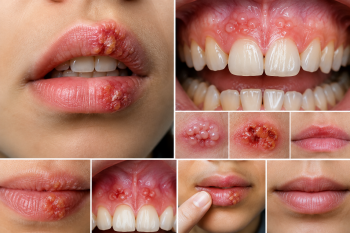
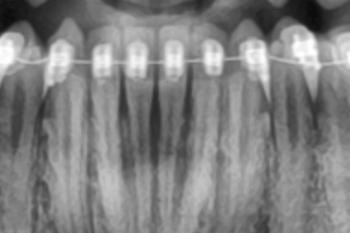
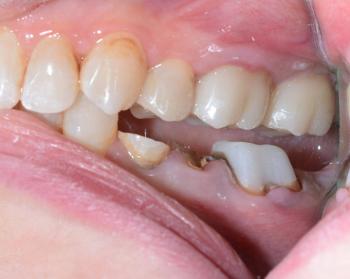
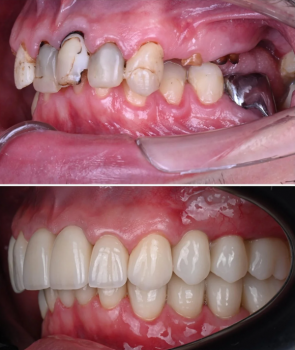
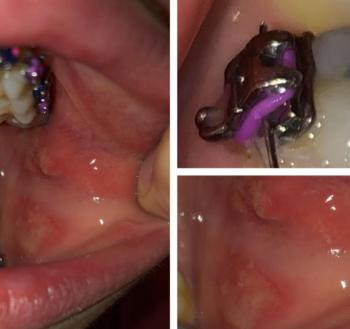
Patients with lower front gum inflammation may also experience tartar buildup, periodontal disease, gum abscesses, or tooth decay. Explore these related clinical case studies.


Other topics:
Other Dental Clinic