We Bring Back the Sparkle in Your Smile.

Severe Tooth Decay: Can a Badly Decayed Tooth Be Saved? Treatment, Symptoms & When to See a Dentist
Image:
Severity:
Teeth Problems:
Yes — this is a serious-looking dental case, but it is treatable. The most important point is not to wait 14 days before getting it examined.
100% visual assessment
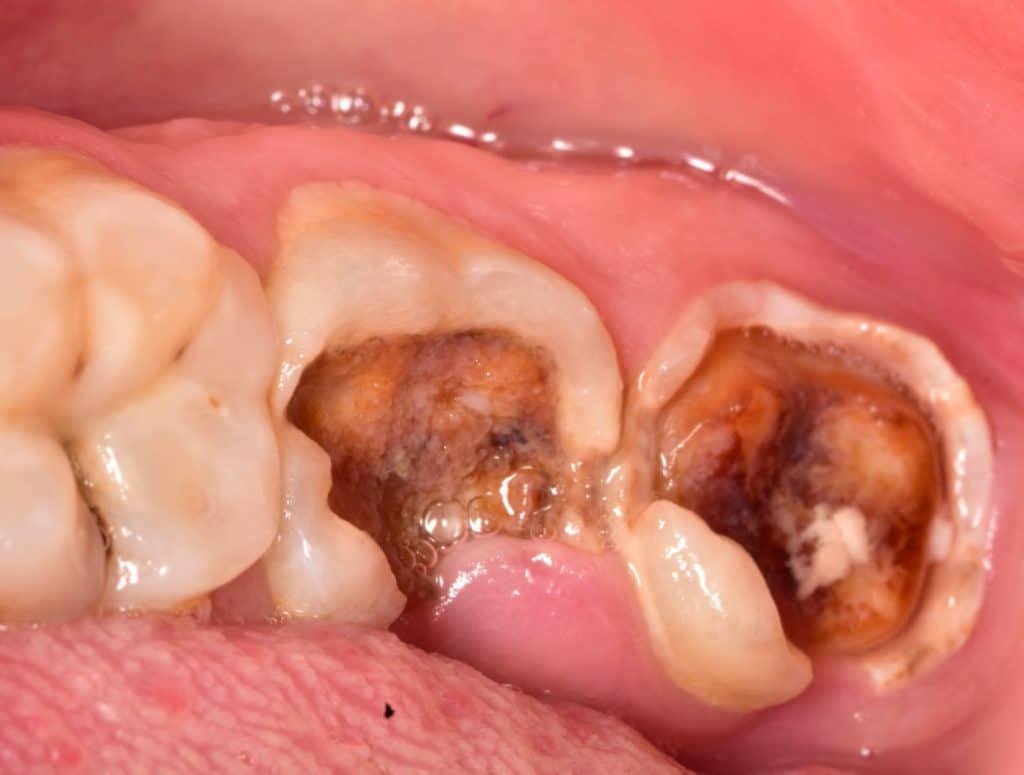
Looking closely at the photograph:
- Back molar: There appears to be extensive cavitation/coronal tooth destruction. A very large portion of the chewing surface is missing.
- The dark brown/black material is highly suspicious for advanced dental caries (tooth decay), although some discoloration can also represent stained or softened tooth structure.
- The cavity appears deep enough that pulp/nerve involvement is a significant concern.
- The adjacent molar also appears to have a large area of decay or a defective/previous restoration with substantial structural loss.
- The surrounding gum tissue is visible but the photograph alone cannot determine whether there is an abscess, bone loss, or infection around the roots.
- The smaller tooth in front appears comparatively more intact, although a clinical examination is needed to assess it properly.
Important limitation: A photograph cannot establish whether the pulp is alive, whether there is an abscess at the root, or whether either molar can be saved. Dental X-rays plus pulp testing are needed.
Advanced decay can progress from a cavity to pulp inflammation/necrosis and eventually a dental abscess.
How worried should you be?
Your fear that it could get worse is understandable. I would not ignore this case. However, the photograph does not mean that the teeth are automatically hopeless or that a dangerous infection is already present.
The biggest risk of waiting is that:
deep cavity → pulp inflammation → pulp death → infection around the root → abscess/swelling → possible spreading infection
A dental abscess does not normally disappear by itself and requires dental treatment.
What should happen next?
Ideally: dental appointment within 24–72 hours, rather than waiting 14 days.
At the appointment, the dentist would typically determine:
- Clinical examination
- Dental X-rays — especially periapical/bitewing imaging
- Pulp vitality testing
- Check for pain when biting/tapping
- Check gum probing and periodontal condition
- Determine whether the tooth has enough remaining structure to restore
- Assess the roots and surrounding bone
- Establish whether there is an abscess
The treatment could then be one of several paths:
If the nerve is still healthy enough:
Decay removal → protective restoration → filling/onlay/crown depending on remaining structure.
If the nerve is irreversibly inflamed or infected but the tooth is structurally salvageable:
Root canal treatment → buildup → usually a crown/onlay to protect the weakened tooth.
If the tooth is too structurally destroyed to predictably restore:
Extraction may be recommended, followed by discussion of replacement options.
The ADA emphasizes definitive dental treatment such as restoration, pulpotomy/pulpectomy, root canal treatment, or drainage when indicated rather than relying on antibiotics alone.
If you wait 14 days
A 14-day delay doesn't guarantee that the condition will deteriorate, but with cavities this extensive, I would not deliberately wait.
Possible escalation during that period:
| Possible development | What it could mean |
|---|---|
| Increasing sensitivity | Decay approaching/involving pulp |
| Severe spontaneous pain | Possible irreversible pulp inflammation |
| Pain suddenly disappears | Not necessarily improvement — pulp may have died |
| Pain when biting | Possible inflammation around the root |
| Bad taste/pus | Possible dental infection/abscess |
| Gum swelling | Infection may be developing |
| Facial/jaw swelling | More advanced infection |
| Fever/malaise | Possible systemic involvement |
An important misconception is that "no pain" doesn't necessarily mean the tooth is okay. Tooth decay can initially be asymptomatic, and infection can develop later.
Do not wait 14 days if these occur
Seek urgent dental care immediately if there is rapidly increasing swelling, severe uncontrolled pain, pus/bad taste with swelling, fever, or difficulty opening the mouth.
Go to an emergency department immediately if swelling is affecting the throat/neck or you have difficulty breathing, swallowing or speaking. Those can indicate potentially dangerous spreading infection.
Visual severity: HIGH.
Confirmed infection: Cannot be determined from the photo.
Probability of needing substantial treatment: HIGH.
Probability the teeth can still be treated: Cannot be determined until X-rays and pulp testing.
Recommended action: Arrange a dentist examination as soon as possible, preferably within a few days.
Most importantly, don't panic and don't assume extraction is inevitable. Even extensively decayed teeth can sometimes be preserved if enough sound structure and healthy root support remain. The X-ray and clinical testing will determine that.
Accurate Medical Guidance: Severe Tooth Decay
Severe tooth decay can cause substantial loss of tooth structure and may eventually affect the pulp, the living tissue inside the tooth. However, the appearance of a severely damaged tooth does not by itself determine whether the tooth can be saved.
A dentist needs to evaluate the tooth clinically and, when indicated, use dental X-rays and pulp or vitality testing. The assessment may also include checking the gums, bite, roots, and supporting bone. These findings help determine whether the tooth is restorable and which treatment is appropriate.
Can a Severely Decayed Tooth Be Saved?
Sometimes, yes. A severely decayed tooth may still be treatable if enough healthy tooth structure remains and the tooth has adequate supporting tissues.
Depending on the condition, treatment may include removal of decayed tissue followed by a filling or another restoration. If the pulp is irreversibly inflamed or infected but the tooth remains restorable, root canal treatment may be considered. A weakened tooth may subsequently require a crown or another protective restoration.
If there is not enough sound tooth structure to restore the tooth predictably, or other clinical factors make long-term restoration unlikely, extraction may be recommended.
Therefore, severe decay does not automatically mean that a tooth must be extracted, but it also cannot be assumed that the tooth can be saved without an examination.
What Symptoms Can Occur With Advanced Tooth Decay?
Advanced decay may cause:
-
Tooth sensitivity to hot, cold, or sweet foods and drinks
-
Toothache or spontaneous pain
-
Pain when biting or chewing
-
A visible cavity or missing tooth structure
-
A broken or weakened tooth
-
Bad taste or drainage if infection develops
-
Swelling around the tooth or gums
-
Facial or jaw swelling when infection spreads
Importantly, the absence of pain does not prove that a severely decayed tooth is healthy. A tooth can have significant decay without causing obvious symptoms, and symptoms can change if the pulp becomes severely damaged or dies.
What Happens When Decay Reaches the Pulp?
When decay progresses deeply into the tooth, bacteria and inflammation can affect the pulp.
Depending on the condition, the pulp may become inflamed and painful. If the pulp becomes irreversibly damaged or dies, infection can develop around the root.
At that stage, treatment may involve root canal treatment if the tooth is restorable, or extraction if the tooth cannot be predictably restored.
Does Severe Tooth Decay Always Need a Root Canal?
No.
Root canal treatment is not automatically required simply because a cavity is large. It may be recommended when the pulp is irreversibly inflamed or infected and the tooth can still be restored.
If the pulp remains healthy and the decay can be removed without compromising the pulp, a different restoration may be appropriate.
A dentist must assess the individual tooth before recommending treatment.
When Is Tooth Extraction Necessary?
Extraction may be recommended when a tooth cannot be predictably restored.
Factors that may influence this decision include:
-
How much healthy tooth structure remains
-
The location and extent of the decay
-
The condition of the pulp
-
The condition of the roots
-
The amount of supporting bone and gum tissue
-
Whether the tooth can be adequately restored
-
The overall prognosis of the tooth
Extraction is therefore one possible treatment outcome, not an automatic consequence of severe decay.
Can a Dental Infection Be Treated With Antibiotics Alone?
Usually, antibiotics do not eliminate the underlying cause of tooth decay or replace definitive dental treatment.
The American Dental Association recommends prioritizing appropriate dental treatment—such as root canal treatment, drainage when indicated, or extraction—rather than relying on antibiotics alone for most pulpal and localized dental conditions in otherwise healthy adults. Antibiotics may be appropriate when there are signs of systemic involvement, such as fever or malaise, or in certain higher-risk situations.
Patients should not start, stop, or reuse leftover antibiotics without professional advice.
Can a Dental Abscess Go Away on Its Own?
A dental abscess should not be assumed to resolve permanently without treatment. An abscess is an infection involving a collection of pus and requires prompt dental assessment and treatment.
Even if pain temporarily decreases, the underlying dental problem may still be present.
When Should You See a Dentist?
A dental appointment should be arranged promptly if you have:
-
A large or deep cavity
-
A broken tooth associated with decay
-
Persistent tooth sensitivity
-
Toothache
-
Pain when biting
-
Gum swelling near a damaged tooth
-
Pus or an unpleasant taste associated with a tooth
-
A tooth that appears substantially damaged
The sooner a severely damaged tooth is evaluated, the sooner the dentist can determine whether restorative treatment is possible.
When Is Severe Tooth Decay an Emergency?
Seek urgent dental evaluation if you develop significant swelling, fever, rapidly worsening symptoms, severe pain, pus associated with swelling, or difficulty opening your mouth.
Seek emergency medical care immediately if dental or facial swelling is accompanied by difficulty breathing, swallowing, or speaking, or if there is substantial swelling involving the mouth, throat, neck, or area around the eye. These symptoms can indicate a potentially serious spreading infection.
Important Limitation of Dental Photos
A photograph can show visible tooth damage, but it cannot reliably determine:
-
Whether the pulp is alive
-
Whether the pulp is irreversibly inflamed
-
Whether an abscess is present around the root
-
Whether there is bone loss
-
Whether the tooth is restorable
-
Whether root canal treatment or extraction is required
A clinical examination, appropriate dental imaging, and other diagnostic tests may be necessary.
For this reason, online photographs should be used for education and triage—not as a definitive diagnosis or treatment plan.
Key Takeaway
A badly decayed tooth should not be ignored, but severe appearance does not automatically mean the tooth is hopeless. Some extensively damaged teeth can still be treated when sufficient healthy structure and supporting tissues remain.
The appropriate treatment may range from restorative treatment to root canal therapy and protective restoration, while extraction may be necessary when the tooth cannot be predictably restored.
Only an in-person dental examination, supported by appropriate diagnostic testing, can determine the condition and prognosis of an individual tooth.
Medical disclaimer: This information is provided for general educational purposes and does not replace an examination, diagnosis, or individualized treatment plan from a qualified dental professional.
Frequently Asked Questions About Severe Tooth Decay
1. Can a badly decayed tooth still be saved?
Yes, some badly decayed teeth can still be saved. The dentist needs to determine how much healthy tooth structure remains, whether the pulp is affected, and whether the tooth has adequate root and bone support. An examination and dental X-rays are often needed before deciding between restoration, root canal treatment, or extraction.
2. How do I know if my tooth decay is severe?
Severe decay may involve a large cavity, significant loss of tooth structure, a broken or weakened tooth, persistent sensitivity, pain, pain when biting, or signs of infection. However, the severity cannot be reliably determined from symptoms or a photograph alone.
3. Can a large cavity be repaired with a filling?
Sometimes. If enough healthy tooth structure remains, a dentist may be able to remove the decayed tissue and restore the tooth with a filling or another restoration. When the tooth has lost substantial structure, an onlay or crown may be more appropriate.
4. Does severe tooth decay always require a root canal?
No. A root canal is generally considered when the dental pulp has become irreversibly inflamed or infected and the tooth is still restorable. A tooth with extensive decay may sometimes be treated without root canal therapy if the pulp remains healthy and the decay can be removed safely.
5. When does a badly decayed tooth need to be extracted?
Extraction may be recommended when the tooth cannot be predictably restored, such as when there is insufficient remaining tooth structure or other factors make long-term restoration unlikely. The decision should be made after a clinical examination and appropriate imaging.
6. Can a broken tooth caused by decay be saved?
Possibly. A broken tooth may still be treatable if sufficient healthy structure remains and the roots and surrounding tissues are suitable for treatment. Depending on the damage, treatment may involve a filling, buildup, crown, or root canal followed by restoration.
7. Can a decayed tooth be rebuilt with a crown?
In some cases, yes. A crown can protect and restore a weakened tooth when enough suitable tooth structure remains to support the restoration. A dentist must first determine whether the tooth is structurally and biologically suitable for a crown.
8. Can severe tooth decay cause an infection?
Yes. Advanced decay can reach the pulp inside the tooth. If the pulp becomes severely inflamed or dies, bacteria can subsequently cause infection around the root and potentially form an abscess.
9. Can a tooth infection go away on its own?
A dental abscess should not be assumed to resolve permanently on its own. Definitive dental treatment is usually needed to address the source of the infection. Depending on the condition, treatment may involve drainage, root canal treatment, or extraction.
10. Can antibiotics cure severe tooth decay?
No. Antibiotics do not remove tooth decay or repair a damaged tooth. For many localized dental conditions, definitive dental treatment is the priority rather than antibiotics alone. Antibiotics may be appropriate when there are signs of systemic involvement or spreading infection, based on a dentist's assessment.
11. Is severe tooth decay always painful?
No. A severely damaged tooth may sometimes cause little or no pain. Lack of pain does not necessarily mean that the tooth is healthy. In some situations, pulp damage or death can change the way the tooth responds to temperature and pain.
12. What does it mean if my tooth suddenly stops hurting?
A sudden reduction or disappearance of pain does not necessarily mean the problem has healed. If the pulp has become severely damaged or died, pain may decrease while infection around the root can continue or develop. A dental examination is important when significant decay was previously present.
13. What tests are needed to determine whether a badly decayed tooth can be saved?
A dentist may perform a clinical examination, dental X-rays, pulp or vitality testing, biting or percussion tests, gum assessment, and an evaluation of the remaining tooth structure. These findings help determine whether the tooth is restorable and what treatment may be appropriate.
14. What happens if severe tooth decay is left untreated?
Untreated decay can become deeper and may eventually affect the pulp. Possible complications include severe pain, pulp death, infection around the root, abscess formation, swelling, and potentially spreading infection. The progression varies from person to person, so significant decay should be evaluated rather than monitored indefinitely.
15. When should I see a dentist for severe tooth decay?
Arrange a dental examination as soon as reasonably possible if you have a large cavity, broken tooth, persistent tooth pain, sensitivity, pain when biting, or suspected advanced decay. Urgent care is particularly important if swelling, pus, fever, or rapidly worsening symptoms develop.
16. What are the emergency warning signs of a dental infection?
Seek urgent dental or medical evaluation for rapidly increasing facial or jaw swelling, fever or significant illness, severe worsening pain, difficulty opening the mouth, or swelling associated with an infected tooth.
If swelling affects the neck or throat, or you have difficulty breathing, swallowing, or speaking, seek emergency medical care immediately because a spreading dental infection can become serious.
17. Can a badly decayed tooth be saved without a root canal?
Sometimes. If the pulp is still healthy and the decay can be removed while leaving enough sound tooth structure, the dentist may be able to restore the tooth without root canal treatment. If the pulp is irreversibly inflamed or infected, root canal treatment may be necessary if the tooth remains restorable.
18. What should I do while waiting for my dental appointment?
Keep the area clean with gentle brushing and avoid chewing hard foods on the affected tooth. Do not attempt to remove the decay yourself or place unapproved substances inside the cavity. If pain is present, discuss appropriate pain-relief options with a healthcare professional or pharmacist, particularly if you have other medical conditions or take medications.
Important Reminder
A photograph or symptoms alone cannot determine whether a severely decayed tooth can be saved. A dentist may need an examination, X-rays, and pulp testing to determine the condition of the tooth and recommend appropriate treatment.
This information is for general educational purposes and does not replace an examination, diagnosis, or treatment plan from a qualified dental professional.
Related Clinical Cases
Patients with lower front gum inflammation may also experience tartar buildup, periodontal disease, gum abscesses, or tooth decay. Explore these related clinical case studies.




Other topics:
Other Dental Clinic
 |
 |
 |
 |