From Pain to Perfect — We Care for Your Smile.

What Happens If Dental Clinics Disappear? The Philippines' Hidden Oral-Health Crisis
Language :
Topics:
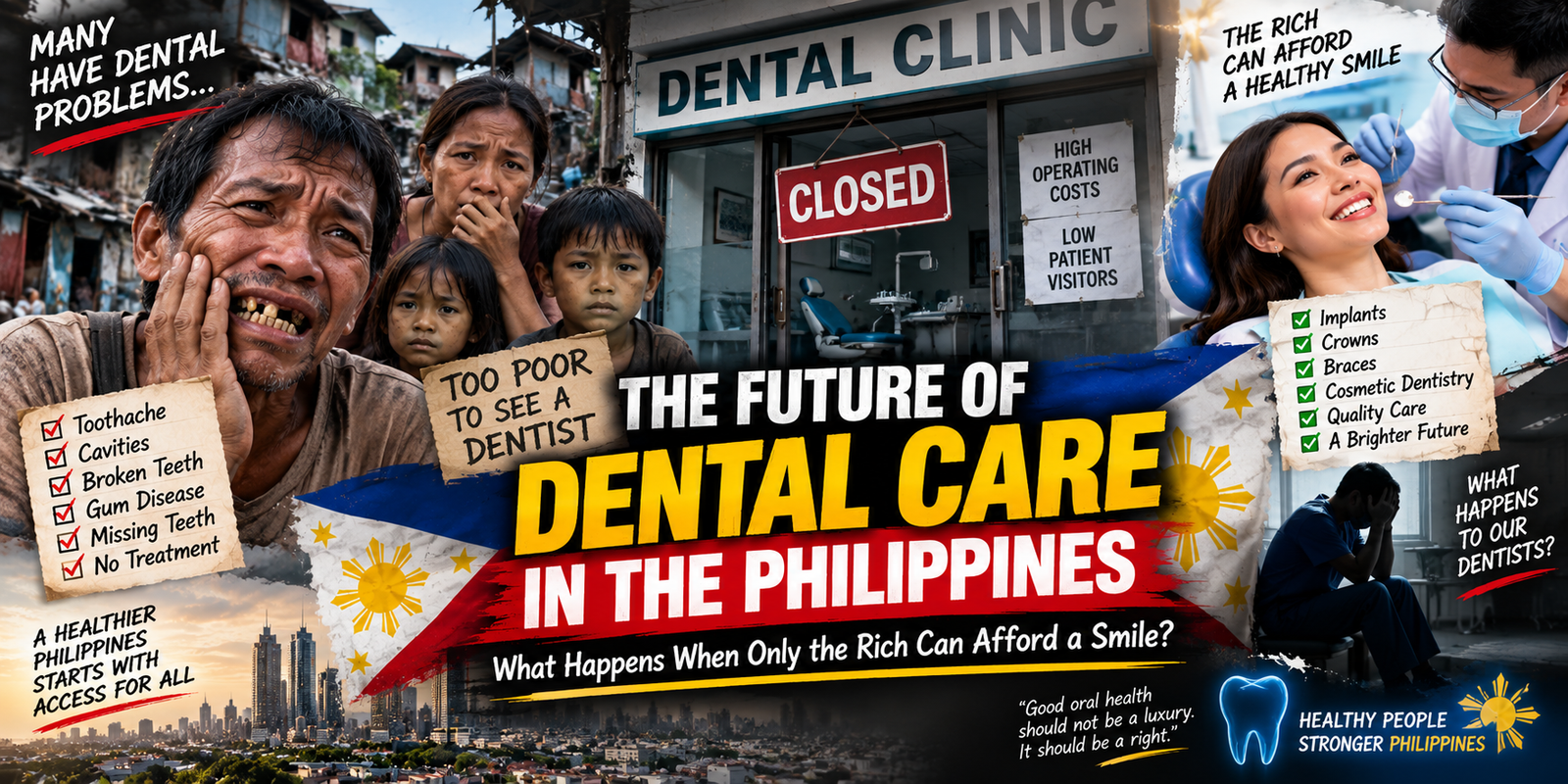
What happens when people need dental treatment—but only a small number can afford to walk through the clinic door?
This is a question that deserves much more attention in the Philippines.
Imagine a community where thousands of people have cavities, broken teeth, gum disease, missing teeth and chronic dental problems.
The need for dental care is enormous.
But only a small percentage of those people can actually afford treatment.
At the same time, the dental clinic has rent to pay.
Electricity.
Dental materials.
Staff salaries.
Laboratory bills.
Equipment.
Sterilization.
Taxes.
Maintenance.
Supplies.
If too few patients are coming through the door, the dentist faces a difficult business problem.
The patients need care.
The dentist needs patients to keep the clinic operating.
What happens when those two realities no longer meet?
A Clinic Can Have Empty Chairs While the Community Has Sick Teeth
This may be one of the strangest contradictions in healthcare.
A dental clinic can have empty chairs while people in the surrounding community have serious dental problems.
The problem isn't necessarily a lack of need.
The problem is lack of purchasing power.
A person may have a badly damaged tooth but decide to wait.
Another may have several missing teeth but continue living without dentures.
Someone else may have gum problems but postpone a dental visit.
Another patient may only visit when the pain becomes unbearable.
The dental chair remains empty—not because people don't need treatment, but because they cannot afford it.
What If Only the Middle Class and Wealthy Can Afford Dentistry?
This creates an uncomfortable question.
If the dental market becomes increasingly dependent on middle- and higher-income patients, who will treat the millions of Filipinos with limited financial resources?
The wealthy can generally seek private dental care.
The middle class may be able to budget for treatment.
But what about families who cannot easily find even a few thousand pesos for unexpected healthcare?
What happens to their broken teeth?
Who restores them?
Who treats their gum disease?
Who extracts severely damaged teeth?
Who helps them replace missing teeth?
And who prevents a relatively manageable dental problem from becoming a serious health problem?
The Poor Cannot Simply "Wait"
A common assumption is that dental treatment can simply be postponed.
Sometimes it can.
But not indefinitely.
A cavity can become larger.
A broken tooth can become infected.
Untreated gum disease can progress.
Dental pain can interfere with eating and sleeping.
An untreated infection can sometimes become a medical emergency.
The longer a problem continues, the treatment options can potentially become more complicated.
This creates a vicious financial cycle:
Low income → delayed dental visit → worsening dental condition → more complicated treatment → higher potential cost → further delay
The people who have the least ability to pay can therefore end up facing the most difficult dental problems.
What Happens to the Dentist?
We also need to look at the other side of the dental chair.
Dentists are healthcare professionals—but they also have to operate businesses.
A dentist cannot simply provide unlimited treatment for free.
The clinic has expenses.
Even when there are only a few patients, the electricity bill still arrives.
The landlord still expects rent.
Employees still need to be paid.
Dental laboratories still charge fees.
Dental materials still have to be purchased.
Equipment still requires maintenance.
Insurance, licenses, taxes and other operating expenses remain.
This creates a fundamental economic problem:
Revenue falls while fixed and operating costs remain.
If that situation continues for a long period, some clinics may have to reduce hours, reduce staff, relocate, merge with another practice, or eventually close.
That is not a prediction that widespread closures are inevitable.
It is the basic financial risk faced by any healthcare practice whose revenue cannot cover sustainable operating costs.
What If a Dental Clinic Closes?
At first, the effect might not be obvious.
One clinic closes.
Patients find another dentist.
But what happens if several clinics in a low-income community close or reduce their services?
Patients may have to travel farther.
Waiting times may increase.
Private fees may become less affordable for some patients.
Emergency dental problems may become more common.
Preventive care may decline.
And patients with limited transportation or financial resources may simply stop seeking treatment.
That is where a private-business problem can become a public-health problem.
Does the Philippine Government Help?
Yes—but government and PhilHealth support should not be confused with comprehensive coverage of every dental procedure.
PhilHealth currently has a Preventive Oral Health Services in Primary Care benefit. PhilHealth's provider data listed 619 accredited preventive oral-health package providers as of July 31, 2026, including 569 government providers and 50 private providers.
PhilHealth's 2024 annual report also identifies the introduction of preventive oral-health services in primary care as one of its expanded benefit packages.
There are also government hospitals providing dental services.
For example, the Department of Health's East Avenue Medical Center lists preventive services such as oral prophylaxis and fluoride therapy, restorative services, and several dental surgical procedures. It also operates a mobile dental program called Biyaheng Kalusugan Pangipin, designed to provide free dental services to underserved communities.
So the answer is not that the government provides nothing.
There are programs.
There are public dental facilities.
There are PhilHealth benefits.
There are community initiatives.
But the larger question is whether these services are sufficient to meet the enormous oral-health needs of a population of more than 100 million people.
Government Assistance Has Limits
A public program can help thousands of people.
But the scale of the country's dental needs is enormous.
And government dental facilities can face their own limitations:
-
Limited dental chairs
-
Limited appointment slots
-
Limited personnel
-
Geographic barriers
-
Long waiting periods
-
Limited availability of specialized treatment
-
Budget constraints
-
Unequal access between urban and rural communities
This is why the private dental sector remains important.
The Philippines needs both:
A strong public oral-health system
and
a financially sustainable private dental industry.
One cannot easily replace the other.
Who Will Save the Broken Teeth?
This is perhaps the most emotional question.
Imagine a poor Filipino worker with several broken teeth.
They work every day.
They have children.
They pay rent.
They buy food.
They pay transportation costs.
They have electricity and school expenses.
They know they need dental treatment.
But the money isn't there.
If the private dentist cannot afford to treat them at a price they can pay, and the public system cannot accommodate them quickly, what happens?
The answer may be:
They live with the problem.
And that should concern everyone.
Because a broken tooth doesn't ask whether someone is rich or poor.
The Oral-Health Divide
We could eventually see a growing divide between two groups.
Group 1: People who can afford private dentistry
They can seek:
-
Regular examinations
-
Professional cleaning
-
Crowns
-
Bridges
-
Root canal treatment
-
Orthodontics
-
Dental implants
-
Cosmetic dentistry
-
Comprehensive restorative care
Group 2: People who struggle to afford treatment
They may rely on:
-
Government clinics
-
Public hospitals
-
Community dental programs
-
Emergency treatment
-
Extraction instead of restoration
-
Delaying treatment
-
Home remedies
-
No treatment at all
That divide is not simply about teeth.
It is about health inequality.
The Risk of an "Extraction Economy"
There is another concern.
When money becomes extremely tight, patients may choose the least expensive immediate solution.
Sometimes extraction is clinically appropriate.
But if extraction becomes the default solution simply because restoration is financially inaccessible, the country could eventually face more people living with missing teeth.
One extraction may solve an immediate problem.
But losing multiple teeth creates another problem.
Eating can become more difficult.
Speech can be affected.
Replacing missing teeth later may require additional treatment.
And comprehensive rehabilitation can be considerably more expensive than early preventive care.
The cheapest immediate option is therefore not necessarily the cheapest long-term option.
What Safety Do Dentists Get?
This question has two meanings.
Financial safety
Dentists need a sustainable income.
They invest years of education and substantial capital into their profession.
If patient numbers fall dramatically while costs continue rising, the dentist can experience financial stress just like any other business owner.
There is no guarantee that a private clinic will remain profitable simply because dental care is medically necessary.
Professional and workplace safety
Dentists also work in clinical environments where infection-control standards, occupational safety, equipment maintenance and appropriate working conditions matter.
A financially stressed clinic should not be forced into unsafe shortcuts simply to reduce costs.
The safety of the dentist, dental staff and patients must remain fundamental.
Dentists Need Protection Too
It is easy to look at the dentist and think:
"They are a doctor. They must be doing well."
But professional status does not eliminate financial pressure.
A dentist may have spent many years paying for education.
They may have borrowed money to establish a clinic.
They may employ several people.
They may support a family.
They may have equipment loans.
They may face increasing rent and supply costs.
A clinic with low patient volume can therefore create significant financial pressure.
If the situation becomes severe enough, some professionals may consider working overseas or changing their business model.
For the individual dentist, seeking a better opportunity can be understandable.
For the country, however, losing experienced healthcare professionals can create another challenge.
The Government Needs Private Dentistry
The Philippines cannot realistically expect government facilities alone to provide every dental service needed by the population.
Private dentists are an important part of the healthcare ecosystem.
That means public policy should consider not only how to help patients afford dental care, but also how to keep dental practices financially viable.
A sustainable system needs both sides.
Patients need affordable access.
Dentists need sustainable reimbursement and operating conditions.
Clinics need to be able to employ staff and maintain equipment.
Dental laboratories and suppliers need functioning markets.
And communities need enough dental professionals available locally.
What Could Help?
A stronger dental-health strategy could include several approaches.
1. Expand preventive dental coverage
Prevention is usually easier to scale than waiting for severe dental disease.
2. Strengthen public dental clinics
More equipment, staff and appointment capacity could help underserved communities.
3. Expand community and mobile dentistry
Government and nonprofit dental programs can reach people who cannot easily travel to private clinics.
4. Improve awareness of early treatment
People should understand that waiting until severe pain develops can lead to more complicated problems.
5. Support sustainable private dental practices
Healthcare policy should recognize that private clinics have real operating costs.
6. Improve access to appropriate financing
Where appropriate, structured payment arrangements could make larger treatments more manageable.
7. Measure oral-health inequality
The country needs good data showing who is receiving dental care—and who is being left behind.
The Future Could Go in Two Directions
There are two very different possibilities.
Scenario One: The system adapts
Government expands preventive care.
PhilHealth benefits become more useful.
Public dental services improve.
Private clinics remain sustainable.
Dentists continue practicing in communities.
Patients receive earlier treatment.
Dental disease is addressed before it becomes severe.
Scenario Two: The gap widens
Patients become poorer.
Dental visits decline.
Clinics struggle.
Some practices reduce services or close.
Dentists seek other opportunities.
Public clinics become overwhelmed.
Poor families delay treatment even longer.
More people live with broken, missing or infected teeth.
Neither scenario is inevitable.
But the direction the country takes matters.
The Most Vulnerable Patient Has No Voice
The patient who cannot afford a dental visit may not appear in clinic statistics.
They don't generate a receipt.
They don't leave a review.
They don't make an appointment.
They simply stay home.
That person can become invisible to the healthcare system.
Meanwhile, dental clinics may look at their appointment books and see fewer patients.
Both sides are suffering from the same underlying problem:
The need for care exists, but the ability to pay does not.
This Is Bigger Than Dentistry
This isn't really just a story about dentists.
It is a story about poverty.
It is a story about healthcare access.
It is a story about professional sustainability.
It is a story about inequality.
And ultimately, it is a story about what kind of healthcare system the Philippines wants to build.
A country should not have a situation where a person has serious dental disease but cannot find an affordable place to receive appropriate care.
At the same time, a dentist should not be expected to operate indefinitely while losing money.
Both problems have to be solved.
Final Thought
A dental clinic with empty chairs can be financially vulnerable.
But a community full of people with untreated dental disease is vulnerable too.
The real danger is when both problems happen simultaneously.
The dentist says:
"I don't have enough patients to keep operating."
The patient says:
"I don't have enough money to get treatment."
And somewhere between those two statements is a public-health crisis waiting to grow.
The Philippines already has government dental programs and PhilHealth's preventive oral-health benefit. But the long-term challenge is making sure that public programs and private dental practices work together rather than leaving millions of people between the two systems.
Because the question is not simply:
"Who can afford a dentist?"
The more important question is:
"What happens to the people who cannot?"
And if we cannot answer that question, the country's dental problems will not disappear.
They will simply become more visible in the smiles of the next generation.
Related Clinical Cases
Patients with lower front gum inflammation may also experience tartar buildup, periodontal disease, gum abscesses, or tooth decay. Explore these related clinical case studies.

Other topics:
Other Dental Clinic