Your Smile, Our Passion.

Periodontal Probing: A Dentist’s Case Study and Clinical Analysis of Gum Health
image hero:
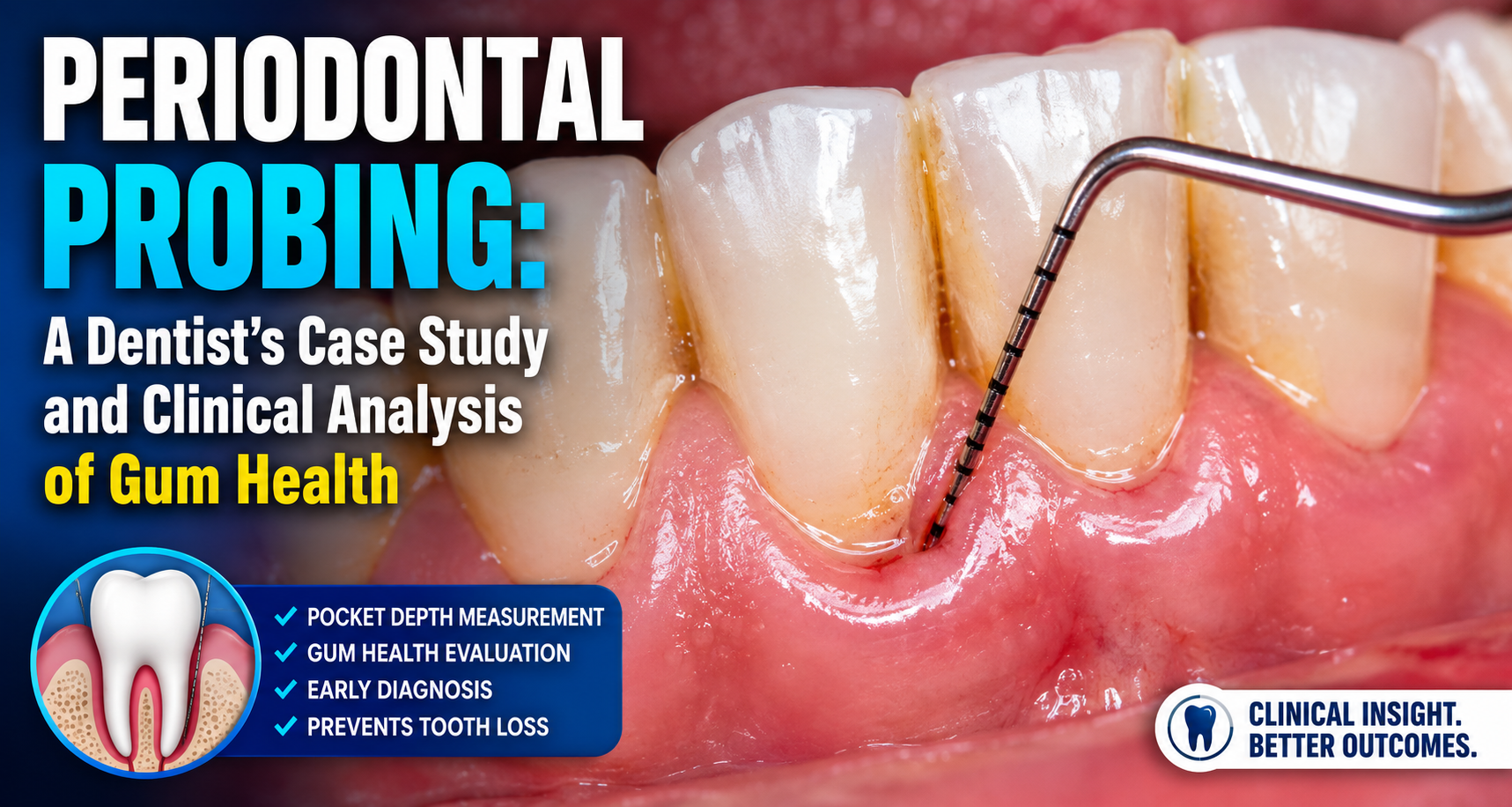
Periodontal probing is one of the most important clinical examinations used by dentists and periodontists to evaluate the health of the tissues supporting your teeth. It is a simple procedure, but the information obtained from a periodontal probe can help identify gingival inflammation, periodontal pockets, attachment loss, bleeding, and other signs that may indicate periodontal disease.
As a dentist practicing in the United States, I consider periodontal probing an essential part of a comprehensive periodontal examination—not simply a measurement of how “deep” the gums are.
The American Academy of Periodontology recognizes the periodontal probe as an important instrument for assessing periodontal tissues. However, probing measurements can be influenced by factors such as probing force, probe angulation, tissue inflammation, anatomy, and the location being examined.
This case study demonstrates how I would interpret periodontal probing findings and how those measurements fit together with clinical examination, radiographs, and the patient's overall risk profile.
Clinical disclaimer: This educational case study uses a hypothetical patient. It is intended for general dental education and does not replace an examination by a licensed dentist or periodontist.
What Is Periodontal Probing?
Periodontal probing involves gently placing a calibrated periodontal probe into the space between the tooth and gum.
The dentist typically records measurements around each tooth at multiple locations. A commonly used approach evaluates six sites per tooth:
- Disto-buccal
- Mid-buccal
- Mesio-buccal
- Disto-lingual or palatal
- Mid-lingual or palatal
- Mesio-lingual or palatal
These measurements help create a periodontal chart, providing a detailed map of the patient's periodontal condition.
A periodontal examination may also evaluate:
- Bleeding on probing
- Gingival recession
- Clinical attachment level
- Plaque accumulation
- Tooth mobility
- Furcation involvement
- Suppuration
- Missing teeth
- Radiographic bone loss
- Occlusal factors
- Relevant medical and behavioral risk factors
The American Academy of Periodontology recommends a comprehensive periodontal evaluation to assess the teeth, gums, plaque, bite, bone structure, and risk factors.
Case Study: Periodontal Probing Reveals Localized Periodontal Disease
Patient
Age: 52
Sex: Male
Location: United States
Chief concern: "My gums bleed when I brush, but my teeth don't hurt."
The patient reports occasional bleeding during brushing and persistent bad breath. He does not report significant tooth pain.
This is an important clinical situation because periodontal disease can progress with relatively little discomfort.
The American Academy of Periodontology notes that gum disease can be relatively silent, while warning signs may include bleeding, receding gums, loose teeth, pus, and persistent bad breath.
Step 1: Visual Examination
During the initial examination, I observe:
- Redness along several gingival margins
- Mild swelling
- Plaque accumulation
- Localized calculus deposits
- Bleeding during periodontal probing
- Mild recession around several teeth
At this stage, visual examination alone does not tell me the full extent of periodontal involvement.
The next step is periodontal probing.
Step 2: Periodontal Probing
The periodontal probe is gently inserted alongside each tooth.
For educational purposes, imagine the following findings:
| Tooth | Representative probing depths | Bleeding |
|---|---|---|
| #3 | 2–3 mm | Minimal |
| #4 | 2–3 mm | No |
| #5 | 3–4 mm | Yes |
| #6 | 2–3 mm | No |
| #14 | 4–5 mm | Yes |
| #18 | 3–4 mm | Yes |
| #19 | 5–6 mm | Yes |
| #30 | 4–5 mm | Yes |
| #31 | 6 mm | Yes |
These numbers would immediately attract my attention.
However, a probing depth by itself does not establish the complete periodontal diagnosis.
That distinction is extremely important.
What Does a 2 mm, 3 mm, or 6 mm Measurement Mean?
A probing measurement represents the distance from the gingival margin to the point reached by the periodontal probe.
A deeper measurement can occur because of different clinical situations.
For example:
2–3 mm
This may be compatible with a healthy periodontal site when other findings are also normal.
4 mm
A 4-mm reading requires interpretation. It may represent inflammation, swelling, a deeper sulcus, recession-related anatomy, or periodontal attachment loss depending on the rest of the examination.
5–6 mm
A deeper probing measurement is more concerning, particularly when accompanied by:
- Bleeding
- Clinical attachment loss
- Radiographic bone loss
- Plaque and calculus
- Suppuration
- Tooth mobility
But even a 6-mm measurement should not be interpreted in isolation.
The ADA describes periodontitis as an inflammatory disease involving loss of periodontal tissue attachment and alveolar bone, with clinical findings that can include deep pockets, bleeding on probing, gingival recession, and tooth mobility.
Step 3: Bleeding on Probing
In our hypothetical patient, several sites bleed when probed.
Bleeding on probing, commonly abbreviated BOP, is an important component of periodontal assessment.
But bleeding does not automatically mean that a patient has periodontitis.
Bleeding can indicate gingival inflammation, and the amount of bleeding must be interpreted alongside probing depths, attachment levels, radiographic findings, plaque, and other clinical information.
The American Academy of Periodontology specifically identifies bleeding on probing as an integral component of routine periodontal examination while also noting limitations associated with probing technique and force.
This is why I would never tell a patient:
"You have periodontal disease because your gums bled."
That conclusion would be too simplistic.
Step 4: Clinical Attachment Level
One of the most important measurements in periodontal diagnosis is the clinical attachment level (CAL).
CAL helps determine whether there has been loss of periodontal attachment.
For example, consider a tooth with:
- Probing depth: 6 mm
- Gingival recession: 2 mm
The clinical attachment level would be approximately:
6 mm + 2 mm = 8 mm
That tells us much more about the patient's periodontal support than the probing depth alone.
Now consider a different situation:
- Probing depth: 6 mm
- Gingival margin is 3 mm coronal to the normal reference point
The interpretation can be very different because part of the increased probing depth may result from gingival enlargement or swelling rather than the same degree of attachment loss.
This is why periodontal diagnosis requires multiple measurements.
The AAP's staging framework specifically calls for confirmation of clinical attachment loss and evaluation of radiographic bone loss when establishing the severity of periodontitis.
Step 5: Radiographic Examination
The periodontal chart tells me what is happening clinically around the teeth.
Radiographs provide another important piece of the puzzle: bone support.
In our case study, suppose radiographs show:
- Mild horizontal bone loss around several posterior teeth
- Moderate bone loss around #19 and #31
- No obvious periapical pathology
- Localized areas of reduced alveolar bone support
Now the clinical picture becomes much clearer.
We have:
Deep probing measurements + bleeding + attachment loss + radiographic bone loss
That combination is substantially more significant than any one measurement alone.
Step 6: Tooth Mobility and Furcation
I would then evaluate tooth mobility.
Suppose:
- #19 has mild mobility
- #31 has mild-to-moderate mobility
I would also check the furcation areas of the mandibular and maxillary molars.
Furcation involvement can complicate periodontal treatment because the area between the roots can become difficult to clean.
The presence of mobility and furcation involvement can also influence treatment planning and prognosis.
Clinical Interpretation of the Case
At this point, the hypothetical patient has:
- Multiple bleeding sites
- Several probing depths of 5–6 mm
- Clinical attachment loss
- Radiographic bone loss
- Localized tooth mobility
- Plaque and calculus
- Symptoms including bleeding and bad breath
These findings would warrant a comprehensive periodontal diagnosis rather than simply labeling the patient as having "deep pockets."
The current periodontal classification uses staging and grading to describe periodontitis. Staging primarily communicates severity and complexity, while grading incorporates factors associated with disease progression and risk.
Why Periodontal Probing Matters
A periodontal probe is a relatively simple instrument, but it gives the dentist valuable information.
Think of periodontal probing as creating a topographic map of the gums around every tooth.
Instead of saying:
"Your gums don't look healthy."
we can document:
- Which teeth are affected
- Which surfaces are affected
- How deep the probing measurements are
- Where bleeding occurs
- Where recession exists
- Where attachment has been lost
- Whether certain areas are improving or worsening
This allows treatment to become much more precise.
Case Analysis: Why One Deep Pocket Is Not the Same as Generalized Disease
Suppose a patient has one isolated 6-mm pocket behind a molar.
That does not necessarily mean the entire mouth has advanced periodontal disease.
The dentist must investigate why that measurement exists.
Possible considerations include:
- Localized periodontal destruction
- Food impaction
- Calculus
- Root anatomy
- Furcation involvement
- Gingival enlargement
- Anatomical variation
- Previous periodontal disease
- Local restorative factors
Now compare that with a patient who has:
Multiple 5–7 mm pockets throughout the mouth + widespread bleeding + attachment loss + radiographic bone loss.
That clinical picture is much more consistent with generalized periodontal involvement.
This illustrates why pattern matters.
Periodontal Probing and Treatment Planning
The periodontal chart can help guide treatment.
Depending on the diagnosis and severity, treatment may include:
1. Professional plaque and calculus removal
The first goal is to reduce the bacterial burden and improve oral hygiene.
2. Patient-specific home care
The dentist or hygienist may recommend improvements in:
- Toothbrushing
- Interdental cleaning
- Flossing
- Interdental brushes
- Other individualized oral hygiene techniques
3. Scaling and root planing when indicated
For patients with periodontal disease, nonsurgical periodontal therapy may be appropriate depending on the clinical findings.
4. Periodontal reevaluation
The periodontal tissues can be reassessed after treatment.
The important question becomes:
Did the periodontal condition improve?
5. Periodontal maintenance
Patients with a history of periodontitis often require continuing professional periodontal care and monitoring.
The goal is not simply to make the numbers smaller once.
The goal is to maintain periodontal stability over time.
A Second Case: When Probing Changes the Diagnosis
Consider a 45-year-old patient with apparently healthy-looking gums.
The patient reports:
"My gums don't bleed, so I don't think I have gum disease."
The visual examination appears relatively normal.
However, periodontal probing reveals:
- Mostly 2–3 mm sites
- One 5-mm site
- No significant bleeding at that site
- Mild recession
- No obvious radiographic bone loss
Would I automatically diagnose periodontitis?
No.
I would investigate the isolated measurement and determine whether there is attachment loss, an anatomical explanation, or another cause.
This illustrates an important principle:
Periodontal diagnosis is based on the complete clinical picture—not one number.
Can Periodontal Probing Hurt?
Most patients describe periodontal probing as mildly uncomfortable rather than painful.
Inflamed tissues can be more sensitive.
Some patients may experience:
- Pressure
- Mild discomfort
- Temporary tenderness
- Bleeding from inflamed areas
The technique matters because probing force can influence measurements. The AAP notes that probing force, angulation, tissue condition, site location, anatomy, and probe type can all affect measurements.
If probing is unusually painful, the patient should tell the dental professional.
What Does a Periodontal Chart Tell Me?
A completed periodontal chart allows the dental team to monitor the patient over time.
For example:
Initial examination
6 mm pocket → bleeding → calculus → bone loss
After periodontal therapy
5 mm pocket → less inflammation → reduced bleeding
Maintenance
4 mm pocket → no bleeding → stable over time
The trend is clinically important.
A single measurement is a snapshot.
Repeated periodontal measurements allow the dentist to evaluate stability and change.
The ADA has highlighted research showing that residual periodontal pockets and other factors can influence outcomes during supportive periodontal care, reinforcing the importance of ongoing monitoring.
Periodontal Probing Before Dental Implants
Periodontal health is particularly important when a patient is considering dental implants.
If active periodontal disease is present, I would want to evaluate and manage the periodontal condition before proceeding with implant treatment.
The reason is straightforward:
Implants do not eliminate the need for healthy periodontal and peri-implant tissues.
The patient's overall oral hygiene, periodontal history, bone condition, and risk factors should be evaluated as part of comprehensive treatment planning.
This is particularly important when the patient has a history of periodontal bone loss.
Common Patient Questions
"Does a 4-mm pocket mean I have periodontitis?"
Not necessarily.
A 4-mm measurement must be interpreted with bleeding, attachment levels, recession, radiographic bone loss, and other findings.
"Is 6 mm always severe gum disease?"
Not automatically.
A 6-mm probing depth is clinically significant and deserves evaluation, but the diagnosis depends on the entire clinical picture.
"Why do my gums bleed when the dentist probes them?"
Bleeding can be a sign of gingival inflammation. However, bleeding can also be affected by probing technique and force.
"Can periodontal pockets get smaller?"
Yes. After appropriate periodontal treatment and improved plaque control, inflammation and swelling can decrease, and probing depths may improve. Persistent deeper sites may require additional evaluation or treatment.
"Can I have gum disease without pain?"
Yes.
Periodontal disease can progress with few noticeable symptoms, which is one reason routine periodontal evaluation is important.
Dentist's Clinical Takeaway
From a clinical perspective, periodontal probing should never be treated as a simple "gum depth test."
It is part of a larger diagnostic process.
When I evaluate a patient, I want to connect the following information:
Probing depth
↓
Bleeding on probing
↓
Gingival recession
↓
Clinical attachment level
↓
Radiographic bone loss
↓
Tooth mobility and furcation involvement
↓
Plaque/calculus and risk factors
↓
Diagnosis and treatment plan
This approach provides a much more accurate picture of periodontal health.
Final Case Assessment
In our hypothetical 52-year-old patient, the combination of:
- Repeated 5–6 mm probing depths
- Bleeding on probing
- Clinical attachment loss
- Radiographic bone loss
- Localized mobility
- Plaque and calculus
would justify a comprehensive periodontal assessment and appropriate periodontal treatment planning.
The most important lesson is that periodontal probing is not about finding one "bad number."
It is about identifying patterns of inflammation, attachment loss, pocketing, and periodontal support—and then determining whether those findings are stable, improving, or progressing.
The American Academy of Periodontology emphasizes comprehensive examination as the foundation for periodontal diagnosis and treatment.
For patients, the practical message is simple:
If your gums bleed regularly, your teeth feel loose, your gums are receding, you have persistent bad breath, or your dentist identifies deep periodontal measurements, do not ignore the findings simply because there is no pain.
Early evaluation can provide an opportunity to identify periodontal problems before more supporting tissue is lost.
Key Takeaways
- Periodontal probing measures the depth of the gingival crevice or periodontal pocket.
- Measurements are normally recorded at multiple sites around each tooth.
- Bleeding on probing provides important information about gingival inflammation.
- Probing depth alone cannot establish the complete periodontal diagnosis.
- Clinical attachment level is an important measurement of periodontal support.
- Radiographs help evaluate alveolar bone loss.
- Tooth mobility and furcation involvement can affect prognosis and treatment planning.
- Periodontal findings should be interpreted as a complete clinical pattern.
- Repeated periodontal charting helps monitor changes over time.
- Patients with concerning findings may benefit from evaluation by a dentist or periodontist.
The periodontal probe may be small, but the information it provides can be critical to protecting the teeth and the bone that supports them.
Related Clinical Cases
Patients with lower front gum inflammation may also experience tartar buildup, periodontal disease, gum abscesses, or tooth decay. Explore these related clinical case studies.


Other topics:
Other Dental Clinic
 |
 |
 |
 |