Where Bright Smiles Begin.

Why Missing Teeth Can Cause Your Other Teeth to Shift Out of Alignment
Language :
Topics:
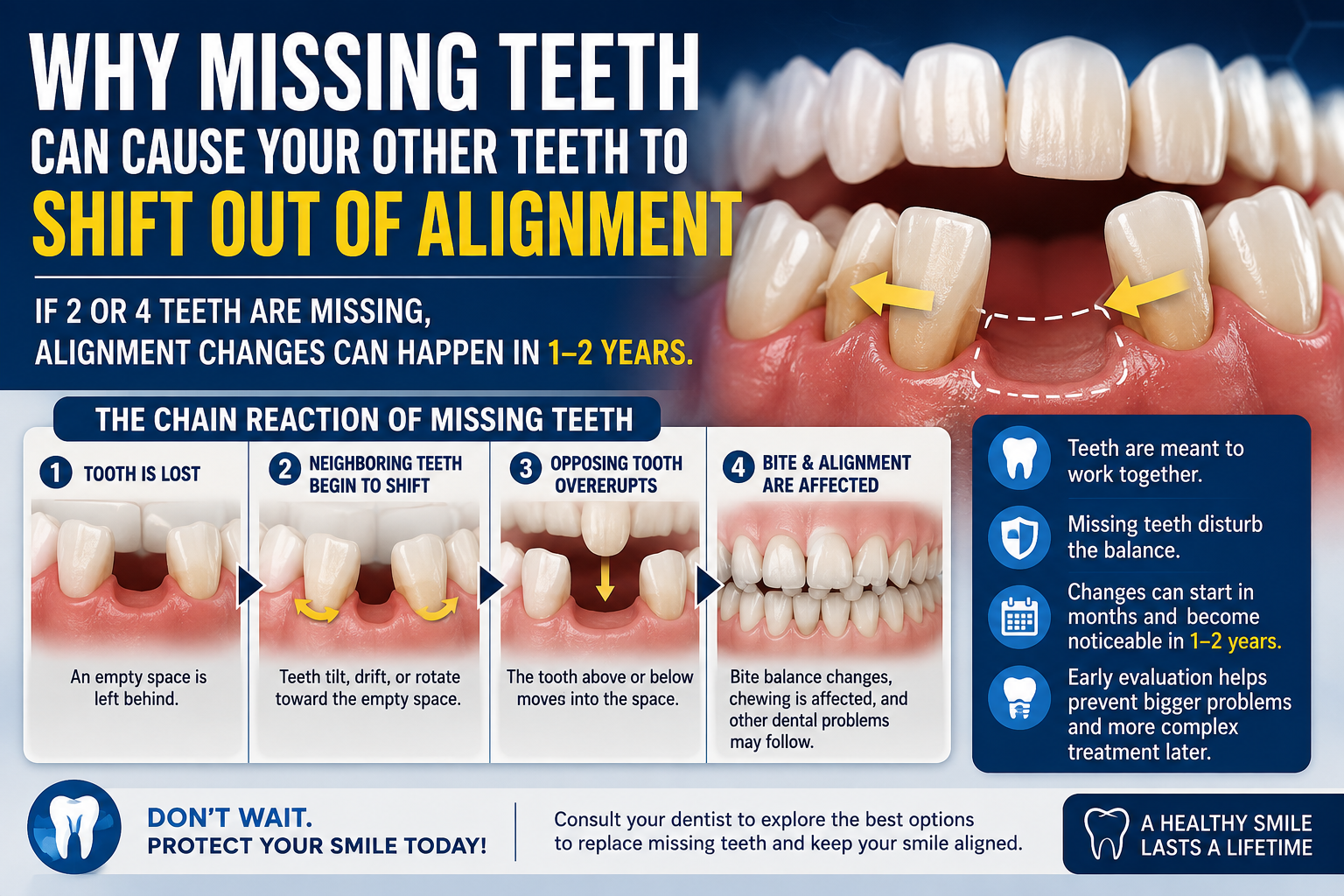
Losing one tooth may seem like a small dental problem, especially when the missing tooth is not visible when you smile. But when two, three, or four teeth are missing, the surrounding teeth can gradually move from their original positions.
This movement can become noticeable within 1–2 years, although the timing varies considerably from person to person. The process is often called tooth migration, drifting, or tilting.
What Happens After a Tooth Is Lost?
Teeth are not completely fixed in the jaw like posts in concrete. Each tooth is supported by the periodontal ligament and is constantly responding to chewing forces, pressure from neighboring teeth, the tongue, lips, and changes in the surrounding bone.
When a tooth is removed, the balance of forces around the empty space changes.
The neighboring teeth may begin to:
-
Tilt toward the empty space
-
Drift sideways
-
Rotate
-
Move farther out of their original alignment
-
Become more difficult to clean
-
Develop changes in the way the upper and lower teeth meet
If several adjacent teeth are missing, the amount of available space is larger and the changes can become more significant.
Why Can It Happen Within 1–2 Years?
There is no universal rule saying that teeth will become misaligned exactly one or two years after tooth loss. However, tooth movement can begin relatively soon after a tooth is lost and may progressively increase over months and years.
The longer the space remains untreated, the more opportunity there is for neighboring teeth to migrate.
For example:
Year 0:
A tooth is extracted and an empty space remains.
Several months later:
The neighboring teeth may begin slowly leaning or drifting toward the space.
Around 1 year:
The change may become more noticeable, particularly if multiple teeth are missing.
Around 2 years or longer:
The teeth may have migrated enough to create a more complicated bite or make future tooth replacement more difficult.
This is not a guaranteed timeline. Some people experience relatively little movement, while others develop substantial migration.
What Happens to the Teeth Beside the Empty Space?
Imagine a missing lower molar.
The tooth immediately in front of the space can begin tilting backward, while the tooth behind the space can move forward.
Instead of remaining upright:
Normal:
| EMPTY SPACE |
The teeth may gradually become:
/ EMPTY SPACE \
As the teeth tilt, the original space can become narrower.
This creates an important problem: the space needed to replace the missing tooth may decrease.
The Opposing Tooth Can Also Move
The problem is not limited to the teeth beside the missing tooth.
The tooth directly opposite the empty space may gradually move farther into the space because it no longer has the same opposing contact during chewing.
This movement is called supraeruption or overeruption.
For example, if a lower molar is missing, the corresponding upper molar may gradually move downward into the space.
Therefore, missing teeth can affect both sides of the bite.
What If 2–4 Teeth Are Missing?
When multiple teeth are missing, the consequences can become more significant.
If two or more neighboring teeth are absent, there is a larger area where surrounding teeth can migrate.
Possible changes include:
-
Neighboring teeth tilt into the spaces
-
Teeth rotate
-
Opposing teeth overerupt
-
The bite becomes less balanced
-
Food becomes trapped more easily
-
Cleaning between teeth becomes more difficult
-
Additional teeth may become overloaded during chewing
The more teeth that are missing and the longer the spaces remain untreated, the greater the potential for progressive changes.
Why Alignment Problems Can Become a Bigger Problem Later
Tooth movement is not only a cosmetic issue.
When teeth drift, the new position can change how chewing forces are distributed.
A tooth that becomes tilted may receive forces differently from when it was upright. Some areas can also become difficult to brush and floss.
This can contribute to:
-
Plaque accumulation
-
Gum inflammation
-
Periodontal problems
-
Food impaction
-
Changes in the bite
-
Increased wear on certain teeth
-
Difficulty replacing the missing tooth
Importantly, missing teeth do not automatically cause severe gum disease or tooth loss, but the altered anatomy can make oral hygiene and bite management more challenging.
Does the Jawbone Also Change?
Yes.
After a tooth is extracted, the bone that previously surrounded the tooth no longer receives the same stimulation from the tooth root. The body gradually remodels the area, and the ridge can lose volume.
This bone remodeling can make the area narrower or less substantial over time.
That becomes particularly important when considering dental implants.
An implant may eventually require sufficient bone volume and adequate space between neighboring roots. If surrounding teeth have migrated significantly, the dentist may need to manage the space before implant placement.
Can the Teeth Be Straightened Again?
Often, yes—but the treatment depends on how much movement has occurred.
A dentist may recommend:
-
Orthodontic treatment
-
A dental bridge
-
A dental implant
-
A removable partial denture
-
A combination of orthodontics and tooth replacement
-
Periodontal treatment when gum disease is present
If teeth have moved substantially, orthodontic treatment may sometimes be necessary to recreate an appropriate space before an implant or bridge can be placed.
Is It Better to Replace Missing Teeth Immediately?
Not every missing tooth needs to be replaced immediately, and the appropriate treatment depends on the location of the tooth, the patient's bite, bone condition, periodontal health, age, and overall dental situation.
However, leaving multiple spaces untreated for years should not be considered harmless simply because there is no pain.
A dental examination can determine whether the remaining teeth are already beginning to migrate.
A Simple Rule to Remember
Missing tooth → altered forces → tooth movement → bite changes → potentially more complicated restoration.
The process is usually gradual rather than sudden.
If you are missing 2–4 teeth, especially adjacent teeth, it is reasonable to have the spaces evaluated before substantial migration occurs.
When Should You See a Dentist?
Arrange a dental examination if you notice:
-
Teeth becoming crooked after an extraction
-
A gap getting smaller
-
Teeth tilting toward a missing tooth
-
Changes in your bite
-
Food repeatedly becoming trapped
-
Difficulty flossing around the area
-
New sensitivity or tooth mobility
-
Gum bleeding or swelling
-
Difficulty chewing
A dentist can use clinical examination and, when appropriate, dental X-rays to evaluate the position of the teeth, bone levels, roots, and available space.
Losing 2–4 teeth can gradually disturb the alignment of the remaining teeth. The neighboring teeth may drift or tilt into the empty spaces, while opposing teeth may overerupt. These changes can begin relatively soon after tooth loss and may become more noticeable over 1–2 years or longer.
There is no exact deadline at which every person's teeth will become misaligned. The rate depends on the location and number of missing teeth, bite forces, periodontal health, age, and individual biology.
The important point is that a missing tooth is not simply an empty space—it can change the mechanical environment of the entire bite.
Early evaluation gives a dentist more options for preserving the space and planning the most appropriate replacement.
QUESTIONS:
Do I Need a Denture or Braces?
Denture and braces do different jobs. You may need one, the other, or a combination depending on how many teeth are missing and whether the remaining teeth have already shifted.
If your main goal is to straighten your teeth:
Braces or clear aligners are used to move teeth into better positions. Orthodontic treatment can close a missing-tooth space or create the correct space for a future replacement.
If your main goal is to replace missing teeth:
A partial denture, bridge, or dental implant can replace the missing teeth. A denture generally does not straighten your natural teeth.
If Your Teeth Have Already Started Moving
A possible treatment sequence is:
- Dental examination and X-rays
- Orthodontic evaluation
- Braces or clear aligners if teeth need repositioning
- Replacement of missing teeth with an implant, bridge, or partial denture
- Retainer to maintain the alignment
If teeth have tilted into the missing spaces, braces may be recommended before replacing the missing teeth so the dentist can establish the correct position and space.
Which Option May Apply?
| Situation | Possible treatment |
|---|---|
| Missing teeth but remaining teeth are well aligned | Tooth replacement may be possible without braces |
| Teeth have tilted into the missing spaces | Braces or aligners may be needed first |
| Missing teeth with significant misalignment | Braces/aligners plus tooth replacement may be appropriate |
| You want a removable replacement | Partial denture |
| You want a fixed replacement | Bridge or dental implant |
| Space needs to be corrected before an implant | Orthodontics followed by implant |
Do not automatically choose a denture just because 2–4 teeth are missing. The best treatment depends on which teeth are missing, how much the remaining teeth have shifted, your bite, gum health, and available bone.
If your goal is specifically “I want my teeth aligned again,” braces or clear aligners are generally the treatment that actually moves the natural teeth. A denture primarily replaces missing teeth.
Watch the video for a simple explanation of why missing teeth can cause your other teeth to gradually shift out of alignment.
Ready to get expert guidance?
If you’re experiencing severe pain or delayed healing, book a consultation with our Cebu dental specialists to get proper evaluation and care.
Consultation or contact page .
Book a Consultation
For severe discomfort or delayed healing, book a consultation with our Cebu dental specialists today.
Looking for a dentist? Browse our Cebu dental directory to find trusted clinics near you.
Medical Review and Clinical Basis
This article is based on clinical dental guidelines and real patient recovery patterns observed after tooth extraction procedures. The information reflects common post-extraction healing stages, including normal clot formation, gum tissue repair, and signs of possible complications such as dry socket or infection.
While mild discomfort is expected after a dental extraction, worsening pain after Day 3, bad odor, exposed bone, or spreading pain may require professional evaluation. These symptoms are consistent with known post-extraction complications described in standard dental practice.
About Cebu Dental Implants
Cebu Dental Implants provides comprehensive tooth extraction, surgical procedures, and dental implant services in the Philippines. Our team evaluates post-extraction healing, manages complications such as dry socket, and advises patients on proper aftercare to prevent infection and delayed healing.
If you experience severe pain or unusual symptoms after extraction, early professional assessment is recommended to prevent further complications.
Important Medical Disclaimer
This content is for educational purposes only and does not replace professional dental diagnosis. Every patient heals differently. If symptoms worsen or do not improve within a few days, consult a licensed dentist for proper evaluation and treatment.
Author
This article was prepared by the Cebu Dental Implants content team in consultation with licensed dental professionals experienced in tooth extraction and implant procedures.
Video:
Related Clinical Cases
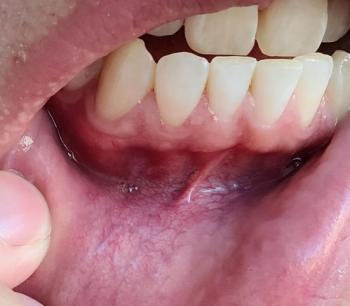
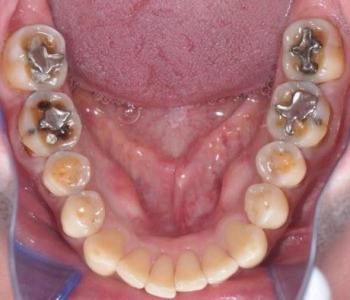
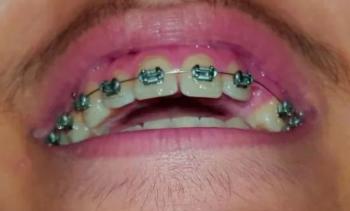
Patients with lower front gum inflammation may also experience tartar buildup, periodontal disease, gum abscesses, or tooth decay. Explore these related clinical case studies.

Other topics:
Other Dental Clinic