Transforming Smiles, Restoring Confidence.

Hospitalization May Be Required After Root Canal Treatment in Yonkers, New York: Understanding Serious Dental Infections, Diagnosis, Treatment, and How Teeth Can Still Be Saved
Language :
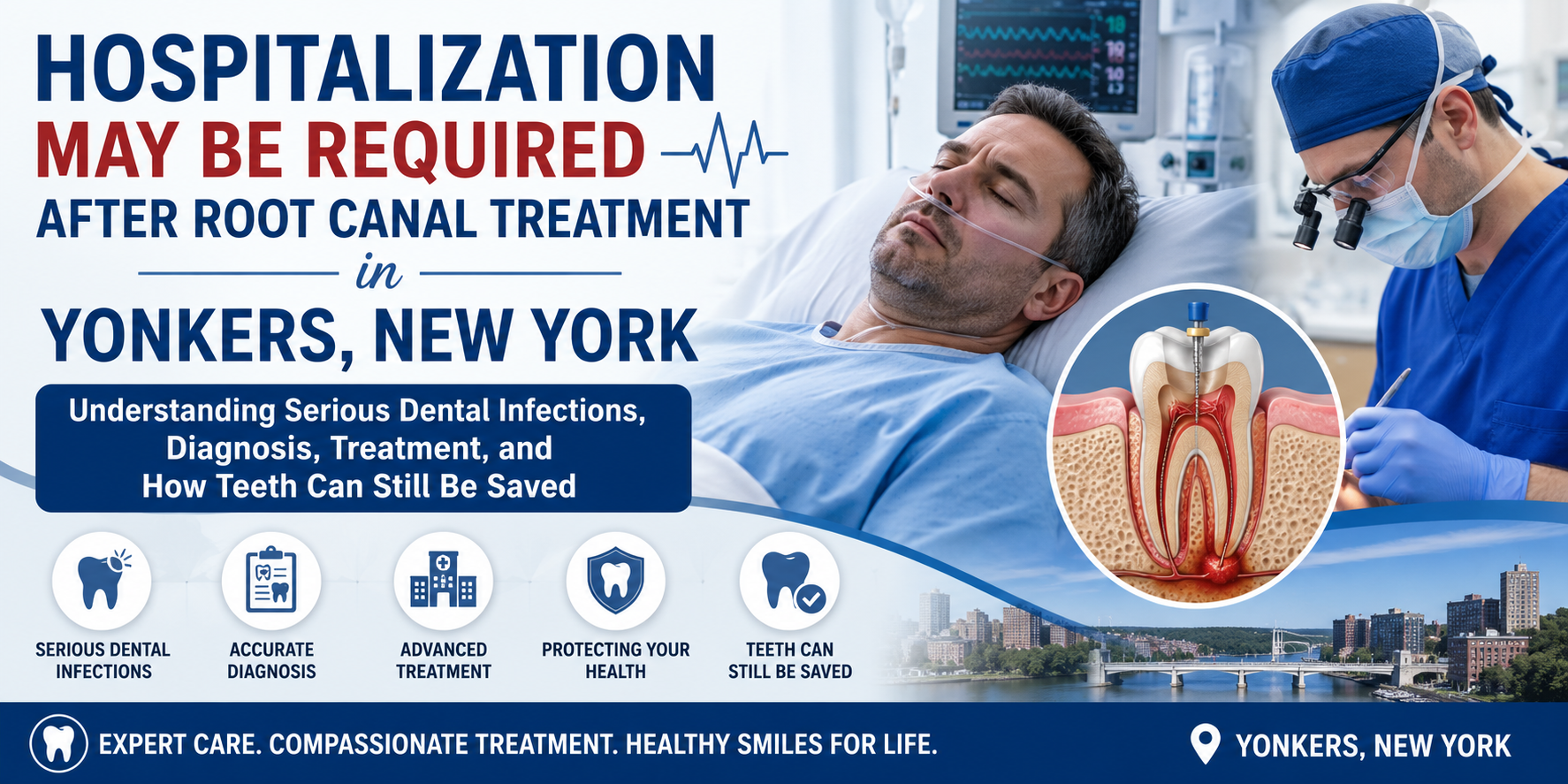
Root canal treatment is one of the most successful procedures in modern dentistry. Every year, millions of Americans undergo root canal therapy to eliminate infection, relieve severe pain, and preserve natural teeth that might otherwise require extraction.
In most cases, recovery is straightforward. Patients return to work, school, and normal activities within a short period of time. However, there are rare situations when complications develop after treatment. In some cases, the infection may continue spreading into surrounding tissues, creating a serious medical condition that requires hospitalization.
Dental organizations across the United States continue to emphasize the importance of recognizing warning signs early. Delayed treatment can transform a manageable dental infection into a significant health emergency.
In Yonkers, New York, dentists and oral health specialists occasionally encounter patients whose infections have progressed beyond the tooth and entered deeper facial spaces. When this occurs, hospital-based treatment may become necessary to protect the patient's overall health and prevent life-threatening complications.
This article explores a real-world style educational scenario illustrating how hospitalization may become necessary after root canal treatment, the diagnostic process used by dental professionals, treatment options available, recovery expectations, and how skilled dental intervention can often save the affected tooth.
A Yonkers Patient's Story
Michael, a 47-year-old Yonkers resident, underwent root canal treatment on a lower molar after experiencing severe tooth pain for several weeks.
Initially, the procedure seemed successful.
The pain subsided significantly during the first few days, and Michael believed the problem had been resolved.
However, approximately one week later, he began noticing:
- Increasing swelling around the jaw
- Difficulty chewing
- Tenderness beneath the chin
- Mild fever
- Fatigue
Believing these symptoms were part of normal healing, he postponed contacting his dentist.
Over the next several days, the swelling expanded.
His wife noticed that one side of his face appeared larger than the other. He also began experiencing difficulty opening his mouth fully.
Concerned, Michael returned to his dentist for evaluation.
The findings suggested that the infection had spread beyond the tooth into surrounding tissues.
He was immediately referred for advanced treatment.
Why Serious Infections Can Occur After Root Canal Treatment
Patients are often surprised to learn that infection may persist even after treatment.
This does not necessarily indicate malpractice or treatment failure.
Many factors influence healing, including:
Complex Root Anatomy
Some teeth contain:
- Hidden canals
- Accessory canals
- Curved canals
- Microscopic branches
These structures can harbor bacteria that are difficult to eliminate completely.
Pre-Existing Severe Infection
Sometimes the infection is already extensive before treatment begins.
The root canal procedure removes infected tissue from inside the tooth, but surrounding bone and soft tissues may require additional healing time.
Delayed Treatment
When patients wait months or years before seeking care, infection may spread beyond the root tips into surrounding structures.
Weakened Immune Response
Certain patients experience slower healing due to:
- Diabetes
- Autoimmune disorders
- Cancer therapies
- Advanced age
- Smoking
- Chronic stress
Cracked Teeth
A microscopic fracture can allow bacteria to re-enter the tooth even after successful treatment.
Understanding Dental Space Infections
The mouth contains multiple tissue compartments known as fascial spaces.
When infection escapes the tooth, it may spread into these areas.
Commonly affected spaces include:
Buccal Space
Located within the cheek region.
Symptoms include:
- Facial swelling
- Tenderness
- Difficulty chewing
Submandibular Space
Located beneath the lower jaw.
Symptoms include:
- Neck swelling
- Jaw discomfort
- Pain while swallowing
Sublingual Space
Located beneath the tongue.
Symptoms may include:
- Tongue elevation
- Difficulty speaking
- Difficulty swallowing
Masticator Space
Involves muscles used for chewing.
Symptoms include:
- Severe jaw stiffness
- Limited mouth opening
- Significant pain
These infections can rapidly worsen if not treated promptly.
When Hospitalization Becomes Necessary
Most dental infections can be managed in a dental office setting.
Hospitalization may become necessary when symptoms suggest a significant threat to health.
Warning signs include:
High Fever
Persistent fever indicates the body is fighting an active infection.
Rapidly Increasing Swelling
Rapid expansion can threaten surrounding tissues.
Difficulty Breathing
Any airway compromise represents a medical emergency.
Difficulty Swallowing
This may indicate infection involving deeper neck spaces.
Severe Facial Cellulitis
Cellulitis occurs when infection spreads throughout soft tissues.
Systemic Illness
Signs include:
- Chills
- Weakness
- Elevated heart rate
- Dehydration
These symptoms require immediate evaluation.
The Emergency Evaluation Process
When Michael arrived at the hospital, specialists conducted a comprehensive assessment.
Medical History Review
Doctors evaluated:
- Current symptoms
- Previous dental procedures
- Medication use
- Existing health conditions
Physical Examination
The examination focused on:
- Airway status
- Facial swelling
- Jaw mobility
- Neck involvement
Imaging Studies
Advanced imaging often includes:
Digital X-Rays
These reveal:
- Bone destruction
- Root anatomy
- Previous treatment quality
CBCT Scans
Cone Beam Computed Tomography provides:
- Three-dimensional imaging
- Precise infection mapping
- Evaluation of surrounding structures
CT Scans
Hospital physicians may order medical CT scans when deep-space infection is suspected.
Diagnosing the Source of Infection
Accurate diagnosis is essential.
The dental team seeks answers to several questions:
Is the Original Infection Still Active?
Bacteria may persist within:
- Root canals
- Root tips
- Adjacent tissues
Is There a Root Fracture?
Cracks can permit continual bacterial contamination.
Is the Tooth Restorable?
Determining whether the tooth can be preserved guides treatment decisions.
Has Infection Spread Beyond the Jaw?
This affects treatment urgency and hospitalization requirements.
Hospital-Based Treatment Options
Michael's infection required admission for aggressive management.
Treatment included several components.
Intravenous Antibiotics
IV antibiotics deliver higher concentrations directly into the bloodstream.
Common choices may include:
- Ampicillin-sulbactam
- Clindamycin
- Piperacillin-tazobactam
Selection depends on:
- Severity
- Medical history
- Allergy status
Intravenous Fluids
Many patients become dehydrated because swelling and pain interfere with eating and drinking.
Pain Control
Comfort measures may include:
- Anti-inflammatory medications
- Prescription analgesics
- Supportive therapies
Monitoring
Hospital teams monitor:
- Airway stability
- Infection progression
- Vital signs
- Laboratory values
Surgical Drainage
In Michael's case, imaging revealed an abscess.
An abscess contains accumulated pus and infected material.
Antibiotics alone often cannot eliminate a large abscess.
Oral surgeons performed drainage to:
- Remove infectious material
- Reduce pressure
- Accelerate healing
- Improve antibiotic effectiveness
This procedure provided immediate relief.
Can the Tooth Still Be Saved?
One of the most common questions patients ask is whether extraction is inevitable.
Fortunately, many teeth remain salvageable.
Factors influencing tooth survival include:
Structural Integrity
If sufficient healthy tooth remains, restoration may be possible.
Root Condition
Healthy roots improve long-term prognosis.
Bone Support
Adequate surrounding bone contributes to stability.
Infection Control
Successful elimination of bacteria significantly improves outcomes.
Advanced Endodontic Retreatment
After stabilization, Michael was referred to an endodontic specialist.
Retreatment involved:
Removing Previous Filling Materials
Existing root canal fillings were carefully removed.
Identifying Missed Canals
Magnification technology helped locate hidden anatomy.
Deep Cleaning
Advanced instruments removed residual infection.
Disinfection Protocols
Specialized solutions targeted remaining bacteria.
Three-Dimensional Sealing
The canals were sealed again to prevent reinfection.
The Role of Modern Technology
Today's endodontic procedures utilize advanced technology that dramatically improves outcomes.
Dental Microscopes
Magnification enables clinicians to identify:
- Tiny canals
- Fractures
- Complex anatomy
Ultrasonic Instruments
These devices assist in:
- Cleaning
- Debridement
- Precision treatment
CBCT Imaging
Three-dimensional imaging improves diagnostic accuracy.
Digital Treatment Planning
Modern planning software enhances precision and predictability.
Recovery After Hospitalization
Recovery varies according to infection severity.
Most patients experience gradual improvement over several weeks.
First Week
Common observations include:
- Reduced swelling
- Improved comfort
- Better jaw movement
Second Week
Patients often notice:
- Increased energy
- Improved appetite
- Decreasing tenderness
One Month
Significant healing is usually evident.
Three to Six Months
Bone regeneration often becomes visible on radiographs.
Long-Term Prognosis
Research consistently demonstrates that appropriately treated root canal teeth can remain functional for many years.
Successful outcomes depend upon:
Proper Restoration
A crown frequently protects treated teeth from fracture.
Good Oral Hygiene
Patients should maintain:
- Daily brushing
- Daily flossing
- Professional cleanings
Regular Monitoring
Routine examinations allow early identification of potential concerns.
What Happens If Treatment Is Delayed?
Untreated dental infections may lead to serious complications.
Potential consequences include:
Bone Destruction
Infection gradually destroys supporting structures.
Facial Cellulitis
Soft tissue infection can spread rapidly.
Tooth Loss
Extensive damage may render a tooth non-restorable.
Airway Compromise
Severe swelling can affect breathing.
Hospitalization
Advanced infections often require inpatient care.
Systemic Infection
In rare cases, bacteria may enter the bloodstream.
This situation can become life-threatening.
Prevention Strategies
The best approach is prevention.
Dental organizations recommend:
Do Not Ignore Tooth Pain
Persistent pain usually indicates a problem requiring evaluation.
Attend Follow-Up Visits
Post-treatment monitoring ensures proper healing.
Complete Prescribed Medications
Patients should follow all instructions carefully.
Report Unusual Symptoms Immediately
Seek evaluation if experiencing:
- Fever
- Increasing swelling
- Difficulty swallowing
- Difficulty breathing
- Severe pain
Maintain Routine Dental Care
Preventive care remains the most effective strategy.
Expert Perspective from U.S. Dental Professionals
Dental experts throughout the United States emphasize an important point:
Hospitalization following root canal treatment is uncommon, but when it occurs, prompt intervention is critical.
Modern dentistry possesses remarkable tools for managing even advanced infections.
Patients should understand that severe swelling, fever, and spreading infection are never normal parts of recovery.
Early diagnosis frequently allows dentists to preserve both oral health and overall well-being.
Most importantly, hospitalization does not automatically mean a tooth is lost.
With coordinated care involving general dentists, endodontists, oral surgeons, and hospital physicians, many teeth can still be successfully saved even after significant complications.
Hospitalization after root canal treatment in Yonkers, New York is rare but may become necessary when infection spreads beyond the tooth into surrounding facial and neck tissues. Symptoms such as fever, increasing swelling, difficulty swallowing, difficulty breathing, or severe facial pain should never be ignored.
The story of Michael demonstrates how rapidly a dental infection can progress—and how modern dental medicine can successfully reverse the situation when treatment is sought promptly.
Through advanced imaging, intravenous antibiotics, surgical drainage, endodontic retreatment, and coordinated specialist care, even severe infections can often be controlled while preserving the natural tooth.
The key message remains clear: early diagnosis, immediate treatment, and ongoing dental follow-up provide the best opportunity for complete recovery, protection of overall health, and long-term preservation of the natural dentition.
Can tooth extraction cause infection? Mild inflammation is normal, but increasing swelling, fever, or severe pain may indicate infection. Learn more about post-extraction infection warning signs in this detailed guide.
Book a consultation with our Cebu dental specialists for proper evaluation and care.
Ready to get expert guidance?
If you’re experiencing severe pain or delayed healing, book a consultation with our Cebu dental specialists to get proper evaluation and care.
Consultation or contact page .
Book a Consultation
For severe discomfort or delayed healing, book a consultation with our Cebu dental specialists today.
Looking for a dentist? Browse our Cebu dental directory to find trusted clinics near you.
Medical Review and Clinical Basis
This article is based on clinical dental guidelines and real patient recovery patterns observed after tooth extraction procedures. The information reflects common post-extraction healing stages, including normal clot formation, gum tissue repair, and signs of possible complications such as dry socket or infection.
While mild discomfort is expected after a dental extraction, worsening pain after Day 3, bad odor, exposed bone, or spreading pain may require professional evaluation. These symptoms are consistent with known post-extraction complications described in standard dental practice.
About Cebu Dental Implants
Cebu Dental Implants provides comprehensive tooth extraction, surgical procedures, and dental implant services in the Philippines. Our team evaluates post-extraction healing, manages complications such as dry socket, and advises patients on proper aftercare to prevent infection and delayed healing.
If you experience severe pain or unusual symptoms after extraction, early professional assessment is recommended to prevent further complications.
Important Medical Disclaimer
This content is for educational purposes only and does not replace professional dental diagnosis. Every patient heals differently. If symptoms worsen or do not improve within a few days, consult a licensed dentist for proper evaluation and treatment.
Author
This article was prepared by the Cebu Dental Implants content team in consultation with licensed dental professionals experienced in tooth extraction and implant procedures.
Related Clinical Cases
Patients with lower front gum inflammation may also experience tartar buildup, periodontal disease, gum abscesses, or tooth decay. Explore these related clinical case studies.