Modern Dentistry, Timeless Smiles.

Bite (Occlusion) Analysis: A California Dentist’s Case Study of How Your Teeth Fit Together
image hero:
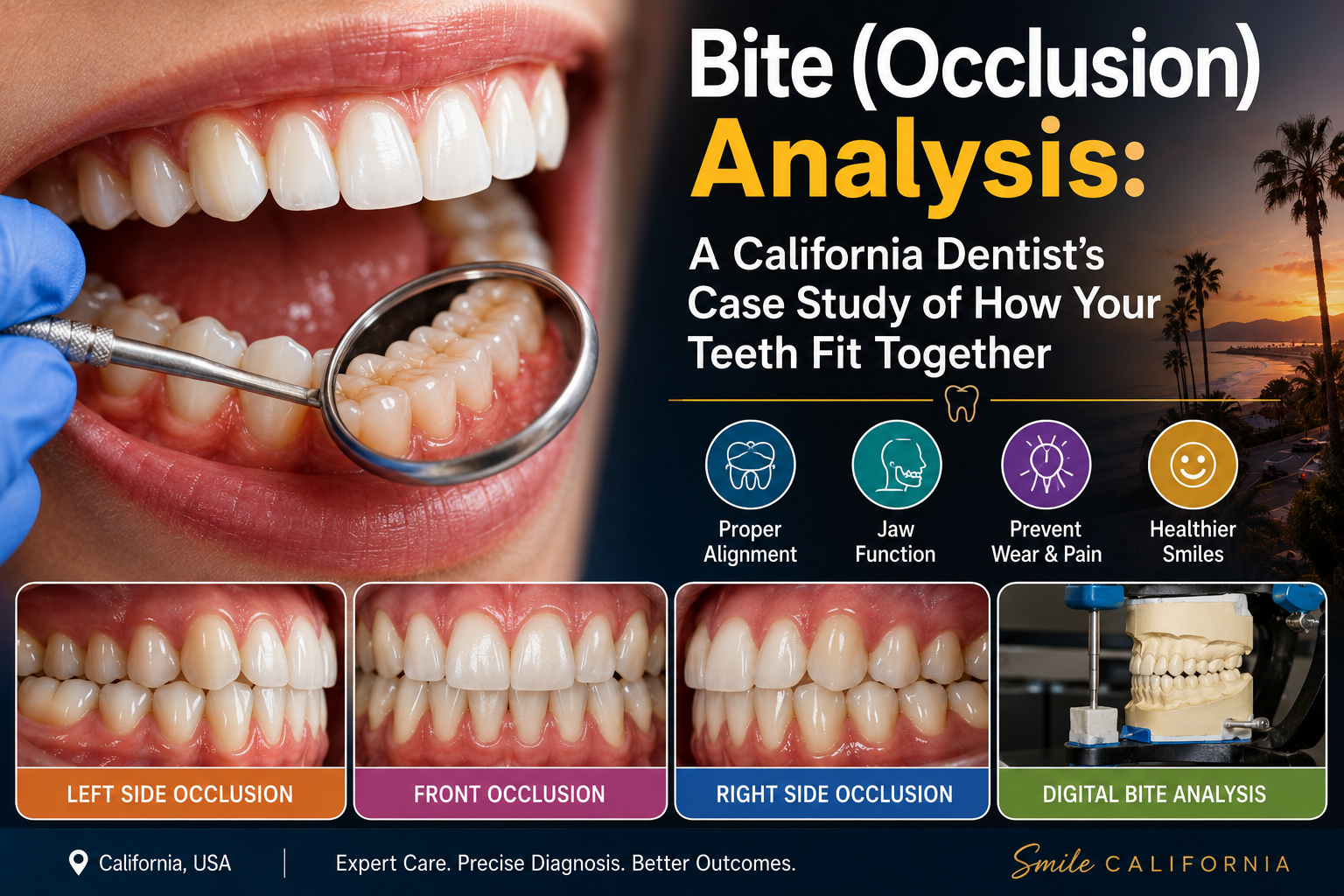
When I evaluate a patient's teeth in a dental office in California, I am not only looking for cavities, broken teeth, or gum disease. I also want to understand how the upper and lower teeth come together when the patient bites, chews, swallows, and moves the jaw.
This relationship is called occlusion, commonly referred to as the patient's "bite."
Occlusion can be an important part of a comprehensive dental examination, particularly when a patient reports uneven tooth contact, difficulty chewing, tooth wear, fractured restorations, jaw discomfort, or changes in the way the teeth fit together.
However, there is an important clinical distinction:
An unusual bite does not automatically mean that a patient has a temporomandibular disorder (TMD).
Current evidence does not support the idea that a "bad bite" by itself causes TMD. The National Institute of Dental and Craniofacial Research (NIDCR) explains that TMDs are a group of conditions affecting the jaw joints, chewing muscles, and surrounding tissues, and that their causes are often multifactorial.
This article presents a hypothetical U.S. case analysis showing how a California dentist might evaluate occlusion and decide whether a patient's bite requires treatment—or simply monitoring.
Educational disclaimer: This is a hypothetical clinical case created for dental education. It is not a diagnosis or individualized treatment recommendation.
What Is Occlusion?
Occlusion describes the relationship and contact between the upper and lower teeth.
When you close your mouth, certain teeth contact each other. When you move your jaw forward or sideways, those contacts change.
A dentist may evaluate:
- How the teeth meet when biting
- Overbite
- Overjet
- Crossbite
- Open bite
- Tooth position
- Premature contacts
- Tooth wear
- Functional contacts
- Jaw movement
- Muscle tenderness
- Temporomandibular joints
- Existing restorations
- Missing teeth
- Tooth mobility
The goal is not necessarily to create a "perfect" bite.
The goal is to understand whether the patient's occlusion is comfortable, functional, stable, and compatible with the health of the teeth and supporting structures.
Why Do Dentists Analyze the Bite?
A bite analysis can be particularly useful when a patient reports:
- "One tooth hits first."
- "My bite feels different."
- "I can't chew comfortably."
- "My crown feels too high."
- "My teeth are wearing down."
- "My jaw clicks."
- "My jaw hurts."
- "My teeth keep breaking."
- "My teeth don't fit together like they used to."
A change in the way the teeth fit together can also be one of the symptoms associated with TMD.
But the clinical evaluation must determine whether the bite is actually contributing to the patient's complaint or whether another dental or musculoskeletal problem is responsible.
Case Analysis: California Patient With an "Uneven Bite"
Patient Profile
Location: California, USA
Age: 48
Sex: Female
Chief complaint: "My bite feels uneven on the right side."
The patient recently received a crown on a lower molar.
Two weeks later, she reports:
"When I close my teeth, the new crown feels like it hits first."
She does not report:
- Significant jaw pain
- Facial swelling
- Difficulty opening her mouth
- Severe headaches
- Tooth sensitivity
This is a common type of situation in which occlusal analysis can be useful.
Step 1: Patient History
Before touching the teeth, I would ask questions.
I want to know:
- When did the bite change?
- Did the sensation begin before or after the crown?
- Does the tooth hurt when chewing?
- Does the tooth hurt when biting and releasing?
- Does the patient clench or grind?
- Is there morning jaw soreness?
- Is there jaw clicking?
- Is there locking?
- Has the patient experienced facial trauma?
- Has orthodontic treatment been performed?
- Are other teeth missing?
- Has the patient recently received other dental restorations?
This history helps distinguish a localized dental problem from a broader jaw or occlusal complaint.
Step 2: Examine the Teeth
I would examine the newly restored tooth first.
I would look for:
- Fracture
- Cracks
- Caries
- Open margins
- Excessive crown contour
- Contact with adjacent teeth
- Food trapping
- Mobility
- Percussion sensitivity
- Thermal sensitivity
- Signs of pulp irritation
A patient who says "my bite is high" may actually have a tooth problem that has nothing to do with the height of the restoration.
For example, a cracked tooth can produce pain when biting even when the occlusion itself is not the primary problem.
Step 3: Evaluate Occlusal Contacts
The dentist can use clinical techniques and materials to evaluate where the teeth contact.
The patient may be asked to:
- Close gently.
- Bite normally.
- Tap the teeth together.
- Move the jaw forward.
- Move the jaw to the right.
- Move the jaw to the left.
The dentist observes whether certain contacts appear early or unusually heavy.
A useful clinical principle is:
Do not evaluate the bite only when the patient is completely still.
Functional jaw movement matters too.
Step 4: Check the New Crown
Suppose the examination shows that the new crown has an occlusal contact that occurs earlier than the surrounding teeth during the patient's normal bite.
The patient confirms:
"That's exactly where I feel the pressure."
Now the clinical findings and the patient's symptoms correlate.
This makes the restoration an important treatment consideration.
However, the dentist should still avoid automatically assuming that every jaw symptom is caused by this contact.
Step 5: Evaluate the Temporomandibular Joints
The temporomandibular joints are located just in front of the ears.
I would evaluate:
- Opening and closing
- Deviation during opening
- Range of motion
- Joint sounds
- Pain
- Tenderness
- Locking
- Muscle tenderness
NIDCR recommends evaluating symptoms and examining the head, neck, face, and jaw when TMD is suspected. Imaging may be considered in selected situations.
Step 6: Evaluate the Chewing Muscles
The masseter and temporalis muscles are particularly important during an orofacial pain examination.
I would assess whether the patient experiences:
- Muscle tenderness
- Fatigue
- Pain during chewing
- Morning soreness
- Headaches associated with jaw activity
This is important because TMDs can involve the chewing muscles as well as the joints.
Case Findings
In our hypothetical California patient, the examination reveals:
| Finding | Result |
|---|---|
| New crown | Present |
| Patient reports high contact | Yes |
| Reproducible early contact | Yes |
| Tooth pain | Mild |
| Jaw pain | No |
| Limited opening | No |
| Joint locking | No |
| Muscle tenderness | Minimal |
| Significant TMD symptoms | Not identified |
At this point, I would focus on the restoration and the patient's functional complaint rather than diagnosing a TMD simply because the patient feels that the bite is uneven.
What Is a "High" Dental Crown?
Patients frequently use the phrase "high crown."
Usually, they mean that the restored tooth appears to contact before the surrounding teeth.
A patient may describe:
"That tooth hits first."
or:
"It feels like I'm biting on one tooth."
This can be a legitimate clinical finding.
If the dentist confirms that the restoration is interfering with the patient's normal occlusion, the dentist may determine whether adjustment of the restoration is appropriate.
However, adjustment should be conservative and based on clinical findings—not simply on the patient's desire to make the teeth feel different.
Bite Analysis Is More Than Checking for "High Spots"
A comprehensive occlusal evaluation may consider:
Static occlusion
How the teeth contact when the patient closes.
Dynamic occlusion
How the teeth interact during jaw movements.
Tooth wear
Flattened, chipped, or worn surfaces may provide clues about long-term functional loading.
Restorations
Crowns, bridges, fillings, veneers, and implants can change contact relationships.
Missing teeth
Missing posterior teeth can alter chewing patterns and tooth contacts.
Tooth mobility
Mobility may indicate periodontal support problems or other pathology rather than an occlusal problem alone.
Jaw function
The dentist considers opening, closing, lateral movements, and symptoms.
Overbite and Overjet
Two terms commonly discussed during an occlusal examination are overbite and overjet.
Overbite
Overbite describes the vertical overlap of the upper front teeth over the lower front teeth.
Overjet
Overjet describes the horizontal distance between the upper and lower front teeth.
These measurements can be useful when evaluating orthodontic relationships and anterior tooth function.
However, an overbite or overjet outside an idealized range does not automatically mean that treatment is medically necessary.
Treatment decisions should consider the patient's actual clinical situation.
Crossbite
A crossbite occurs when one or more upper teeth bite inside the corresponding lower teeth rather than outside them.
Crossbites can occur in the front or back of the mouth.
A dentist may evaluate:
- Number of teeth involved
- Skeletal relationship
- Tooth position
- Functional shift
- Periodontal effects
- Wear
- Patient symptoms
The appropriate management depends on the cause and severity.
Open Bite
An open bite occurs when certain upper and lower teeth do not contact when the patient closes.
Depending on the location, this may affect:
- Chewing
- Speech
- Tongue posture
- Tooth function
- Esthetics
Some open bites are primarily dental, while others have a skeletal component.
Tooth Wear and Occlusion
One of the most interesting parts of bite analysis is examining tooth wear.
A patient may have:
- Flattened incisal edges
- Chipped enamel
- Worn cusps
- Cracked restorations
- Fractured fillings
- Shortened teeth
These findings can be associated with multiple factors, including normal aging, parafunctional activity such as grinding, acid erosion, and other causes.
Therefore:
Tooth wear should not automatically be blamed on occlusion.
A careful dentist considers the entire history.
Bruxism and Bite Analysis
Bruxism refers broadly to repetitive jaw-muscle activity involving clenching or grinding.
A patient may report:
"I grind my teeth at night."
or a dentist may observe signs consistent with excessive mechanical loading.
But the presence of tooth wear does not automatically prove that a specific bite relationship caused it.
Similarly, a patient with bruxism does not necessarily have TMD.
These conditions can overlap, but they are not interchangeable diagnoses.
Does a Bad Bite Cause TMJ Problems?
This is one of the most important questions in modern occlusal dentistry.
The simple answer is:
Not necessarily.
NIDCR states that research does not support the belief that a bad bite or orthodontic braces cause TMD. TMDs are complex conditions with multiple potential contributing factors.
This is why I would be cautious about telling a patient:
"Your jaw pain is caused by your bite."
That statement may be too definitive without a complete evaluation.
Why This Matters Before Permanent Dental Treatment
Suppose a patient has jaw pain and asks for:
- Full-mouth crowns
- Extensive tooth reshaping
- Orthodontic treatment
- Permanent bite reconstruction
solely to treat the jaw pain.
I would want the patient to understand the risks and benefits before making irreversible changes.
NIDCR specifically cautions against treatments that permanently change the teeth, jaw joints, or bite when treating TMD, because evidence for many such approaches is lacking and some procedures may make problems worse.
This does not mean occlusion is irrelevant.
It means the dentist should determine the actual problem before permanently changing the patient's bite.
Case Analysis: What Would I Do?
Returning to our California patient:
Finding 1
A newly placed crown appears to have an early occlusal contact.
Finding 2
The patient can consistently identify that tooth as the source of the unusual bite sensation.
Finding 3
There is no significant jaw pain or functional limitation.
Finding 4
The temporomandibular joint examination is essentially unremarkable.
Clinical reasoning
The most logical first consideration is the recently restored tooth and its occlusal relationship.
This is very different from diagnosing a generalized TMD.
After appropriate clinical evaluation, the dentist may determine whether a conservative adjustment of the restoration is indicated.
The patient should then be reassessed rather than assuming that every symptom has been permanently solved by changing the bite.
What If the Patient Has Jaw Pain?
Now change the case.
Suppose the same patient reports:
- Jaw pain
- Pain when chewing
- Limited opening
- Painful clicking
- Muscle tenderness
- Headaches
- Symptoms lasting several months
The diagnostic approach changes.
At that point, I would evaluate the patient for possible TMD and consider whether referral to an appropriate dental or medical professional is warranted.
NIDCR notes that TMD diagnosis can be difficult because there is no single widely accepted standard test covering all TMD conditions. Diagnosis is based on symptoms, history, examination, and selected imaging when appropriate.
When Is Imaging Needed?
Not every patient with an unusual bite requires advanced imaging.
Depending on the clinical presentation, a dentist or physician may consider:
- Dental radiographs
- Panoramic imaging
- MRI
- CT or other imaging
The appropriate imaging depends on the clinical question.
MRI may be useful for evaluating soft tissues such as the TMJ disc, while CT can provide information about bony structures.
The decision should be based on symptoms and examination findings rather than simply ordering imaging because the bite looks unusual.
Treatment: Start With the Diagnosis
One of my strongest recommendations as a dentist is:
Do not treat an occlusal diagnosis before establishing what problem actually exists.
Depending on the patient, treatment could involve:
- Monitoring
- Restoration adjustment
- Treatment of tooth decay
- Replacement of a defective restoration
- Orthodontic evaluation
- Management of tooth wear
- Treatment of periodontal disease
- Management of bruxism
- Conservative TMD care
- Referral to an orofacial pain specialist
Treatment should be individualized.
For TMD symptoms, NIDCR emphasizes conservative approaches first in many cases and advises caution with irreversible procedures that permanently alter the bite or jaw joint.
Frequently Asked Questions About Bite Analysis
What is a bite analysis?
A bite analysis is a clinical evaluation of how the upper and lower teeth contact and function together.
How does a dentist check my bite?
The dentist may observe your teeth while you close and move your jaw, evaluate tooth contacts, inspect tooth wear and restorations, and examine the jaw joints and chewing muscles when symptoms warrant it.
What does "my bite is off" mean?
Usually, the patient is describing a sensation that the teeth no longer contact in the way they normally do. The dentist needs to determine whether there is a measurable occlusal change or another dental problem.
Can a new crown change my bite?
Yes. A restoration can change the way the teeth contact. If a patient feels that a crown contacts too early, the dentist should examine the restoration and occlusion.
Is a high crown an emergency?
Usually, an uncomfortable or high-feeling crown is not a medical emergency, but it should be evaluated by the treating dentist, particularly if there is significant pain, difficulty chewing, or sensitivity.
Does clicking in my jaw mean I have TMJ disease?
Not necessarily.
NIDCR states that painless clicking or popping sounds are common and generally do not require treatment by themselves. Painful clicking, locking, restricted movement, or other symptoms warrant evaluation.
Can grinding cause tooth damage?
Bruxism can contribute to mechanical stress on teeth and restorations, but tooth wear has multiple possible causes. A dentist should evaluate the overall pattern rather than assuming one cause.
Should my dentist grind my teeth to fix my bite?
Permanent reshaping of teeth should not be performed casually. If the goal is to treat TMD symptoms, NIDCR cautions against irreversible occlusal treatments because evidence does not show that these procedures reliably treat TMD and they can potentially make problems worse.
Can orthodontics fix my bite?
Orthodontics can change tooth position and may be appropriate for certain malocclusions. However, orthodontic treatment should have a clearly established dental or orthodontic indication rather than being presented as a guaranteed treatment for TMD.
Can a bite problem cause tooth fractures?
An abnormal or excessive functional load can be relevant when evaluating fractured teeth, but tooth fractures have multiple possible causes. The dentist should evaluate the tooth, restoration, occlusion, parafunctional activity, and other risk factors.
Can missing teeth affect my bite?
Yes. Missing teeth can change chewing patterns and alter contact relationships between remaining teeth. The clinical significance depends on which teeth are missing and the patient's overall dental condition.
When Should You See a Dentist?
Consider scheduling a dental evaluation if you notice:
- A sudden change in your bite
- A new crown that feels too high
- Persistent tooth pain when biting
- Repeated broken fillings or crowns
- Significant tooth wear
- Jaw pain
- Painful clicking or popping
- Jaw locking
- Difficulty opening your mouth
- Difficulty chewing
- New facial or jaw pain
If you experience significant swelling, difficulty breathing or swallowing, uncontrolled bleeding, or severe rapidly worsening facial symptoms, that requires urgent medical or dental assessment rather than a routine bite analysis.
Final Clinical Perspective
Bite analysis is an important part of comprehensive dentistry, but it needs to be approached carefully.
A patient's teeth are not isolated mechanical components. They function together with:
- Teeth
- Periodontal tissues
- Jaw bones
- Muscles
- Temporomandibular joints
- Nervous system
- Restorations
- Functional habits
When I perform an occlusal evaluation, my objective is not simply to find something that looks different.
My objective is to answer a more important question:
Is the patient's occlusion associated with a clinically significant problem, and if so, what is the most conservative and evidence-based way to address it?
That distinction can prevent unnecessary treatment.
A patient with a high-feeling crown may need a simple restorative evaluation. Another patient with chronic jaw pain may need a comprehensive orofacial pain assessment. A third patient may have an unusual bite that is completely comfortable and requires no treatment.
The correct approach is therefore:
Examine → Measure → Diagnose → Explain → Treat only when indicated → Reassess.
That is the foundation of responsible bite analysis in modern dentistry.
Key Takeaways
- Occlusion describes how the upper and lower teeth contact.
- Bite analysis evaluates both static and functional tooth relationships.
- A "high" crown can create an uncomfortable bite sensation and should be clinically evaluated.
- Tooth wear and fractures have multiple possible causes.
- A bite that looks unusual does not automatically require treatment.
- A bad bite alone is not established as the cause of TMD.
- Painful jaw symptoms require evaluation beyond simply checking tooth contacts.
- Permanent changes to the bite should be approached cautiously.
- Conservative, diagnosis-driven care is generally preferable to irreversible treatment when the diagnosis is uncertain.
- A comprehensive examination is the best way to determine whether an occlusal finding is clinically significant.
The goal of bite analysis is not to create a theoretically perfect bite. The goal is to understand how the patient's teeth and jaw function—and to treat only when the clinical evidence supports treatment.
Related Clinical Cases
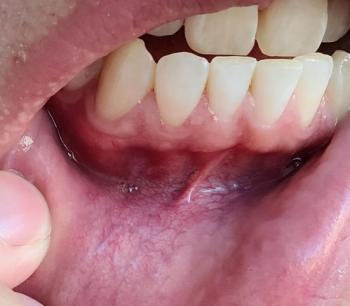
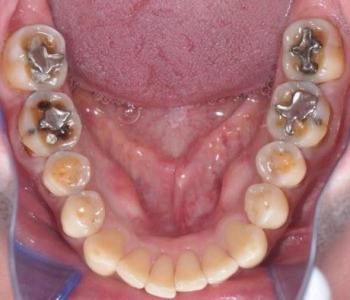
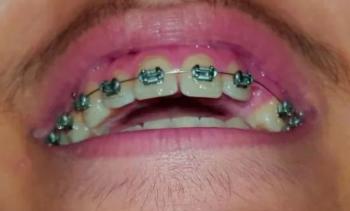
Patients with lower front gum inflammation may also experience tartar buildup, periodontal disease, gum abscesses, or tooth decay. Explore these related clinical case studies.
Other topics:
Other Dental Clinic