Smile Again with Comfort and Confidence.

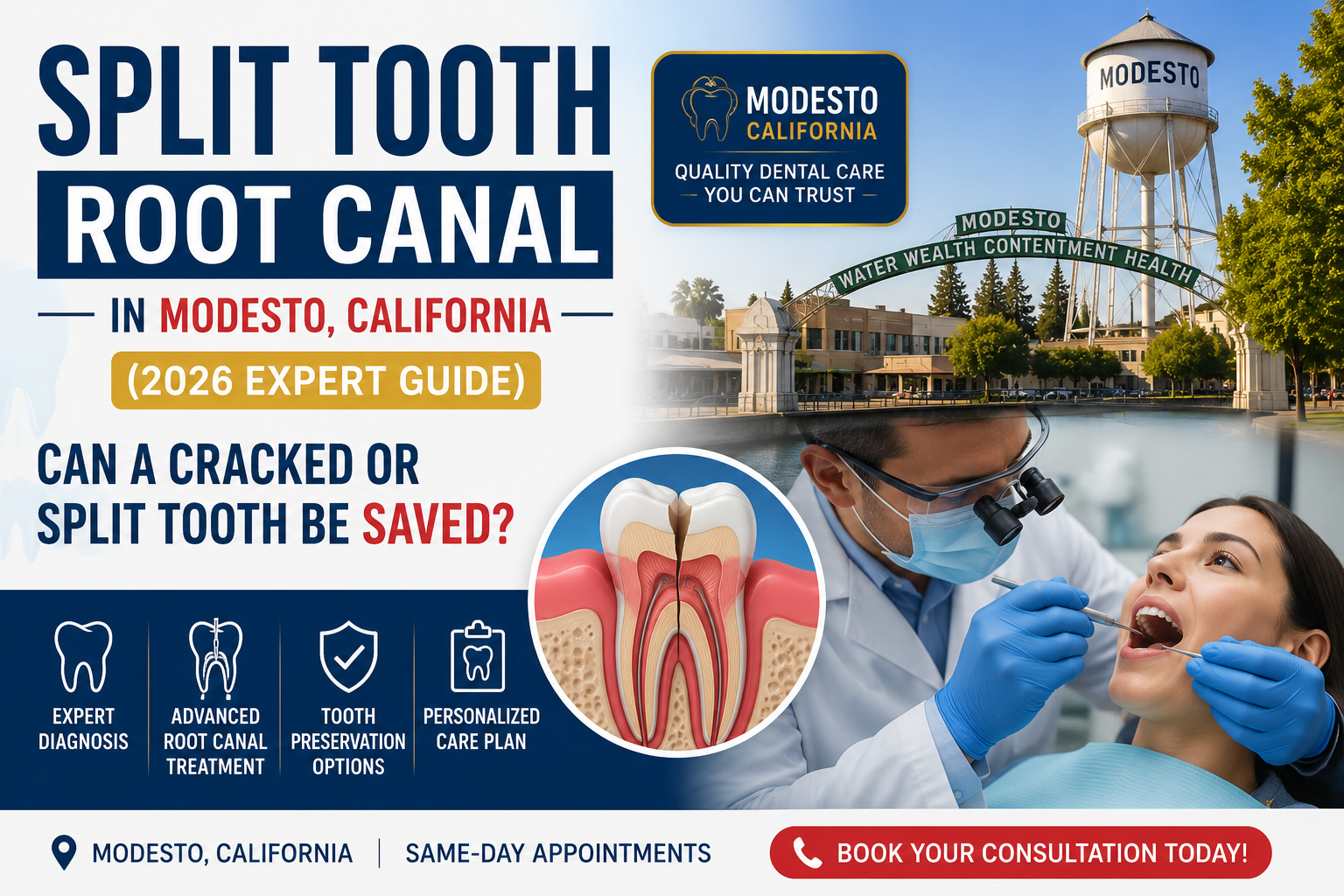
Split Tooth Root Canal in Modesto, California (2026 Expert Guide): Can a Cracked or Split Tooth Be Saved?
Language :
As a dentist who has treated patients across the United States for more than two decades, one of the most alarming situations I encounter is a patient walking into the office saying:
"Doctor, I bit down on something hard and now my tooth hurts every time I chew."
In many cases, the problem turns out to be a split tooth.
A split tooth is one of the most serious dental conditions because the crack often extends deep into the tooth structure and may even reach the root. When left untreated, bacteria can invade the pulp, leading to infection, severe pain, abscess formation, bone loss, and ultimately tooth loss.
For patients in Modesto, California, understanding the difference between a simple crack and a true split tooth can mean the difference between saving a natural tooth with root canal treatment and requiring extraction followed by a dental implant.
This comprehensive guide explains:
- What a split tooth is
- How dentists diagnose cracked and split teeth
- Symptoms that should never be ignored
- When root canal treatment can save the tooth
- Worst-case scenarios if treatment is delayed
- Treatment costs in Modesto, California
- Long-term prognosis and success rates
- Expert advice from a USA dentist
What Is a Split Tooth?
A split tooth occurs when a crack extends completely through the tooth, separating it into distinct segments.
Unlike a minor surface crack, a split tooth is often the result of:
- Long-term crack progression
- Trauma
- Heavy biting forces
- Teeth grinding
- Large fillings weakening tooth structure
The tooth essentially begins breaking into pieces.
When this happens, bacteria gain access to the internal pulp chamber, leading to inflammation, infection, and possible tooth death.
Understanding the Different Types of Tooth Cracks
Not all cracks are the same.
Craze Lines
These are tiny superficial cracks affecting only enamel.
Characteristics:
- Usually painless
- Cosmetic concern only
- No root canal needed
- Extremely common in adults
Fractured Cusp
A portion of the chewing surface breaks.
Symptoms:
- Pain when chewing
- Sharp sensation when releasing pressure
- Usually localized
Many fractured cusps can be treated with crowns without root canal therapy.
Cracked Tooth
The crack extends from the chewing surface toward the root.
Symptoms:
- Intermittent pain
- Sensitivity to cold
- Pain when biting
If the pulp becomes inflamed, root canal treatment may be required.
Split Tooth
The crack completely divides the tooth.
Characteristics:
- Significant structural damage
- Deep bacterial contamination
- Poor prognosis if extensive
This is often the most serious type of crack.
Vertical Root Fracture
The crack begins in the root and moves upward.
Often difficult to detect.
These frequently require extraction because the fracture extends below the gumline.
Why Split Teeth Are Common in Adults
Many Modesto patients are surprised when a tooth suddenly cracks.
In reality, the process may have been developing for years.
Common causes include:
Large Fillings
Large restorations weaken tooth structure.
Each time you chew, microscopic flexing occurs.
Eventually cracks develop.
Teeth Grinding
Bruxism places tremendous pressure on teeth.
Some grinders generate over 250 pounds of force.
This repeated stress creates fracture lines.
Clenching
Daytime clenching can be just as destructive as grinding.
Many patients do not realize they are doing it.
Chewing Hard Foods
Examples include:
- Ice
- Hard candy
- Popcorn kernels
- Nuts
- Bones
One bite can trigger a catastrophic fracture.
Age
Teeth become more brittle over time.
Patients over age 40 experience higher rates of cracked teeth.
Trauma
Sports injuries, accidents, and falls can initiate cracks that worsen over years.
Symptoms of a Split Tooth
One of the biggest challenges is that symptoms are often inconsistent.
Patients frequently say:
"The pain comes and goes."
Typical symptoms include:
Pain When Biting
Especially during release of pressure.
This is one of the classic signs.
Sharp Pain During Chewing
Pain may occur when chewing certain foods.
Temperature Sensitivity
Cold drinks may trigger discomfort.
Sometimes hot beverages cause pain.
Swollen Gums
Inflammation develops near the crack.
Bad Taste
Infection can drain through the gum.
Tooth Mobility
The tooth may feel loose.
Severe Toothache
When the pulp becomes infected, pain can become intense.
Why Split Tooth Pain Can Be Difficult to Diagnose
Many patients expect constant pain.
Instead, split teeth often produce:
- Random pain
- Pain only during chewing
- Sensitivity that disappears
- Symptoms that mimic sinus issues
This makes diagnosis challenging.
Some patients visit multiple dentists before receiving a definitive diagnosis.
How Dentists Diagnose a Split Tooth
Accurate diagnosis is critical.
Several tools may be required.
Clinical Examination
The dentist evaluates:
- Visible cracks
- Gum condition
- Tooth mobility
- Existing restorations
Bite Testing
Patients bite on special instruments.
Pain during release is highly suggestive of a crack.
Magnification
Dental microscopes reveal tiny fracture lines.
Transillumination
A bright light shines through the tooth.
Cracks become visible as dark lines.
Dental X-Rays
Traditional radiographs help identify:
- Infection
- Bone loss
- Root damage
However, cracks themselves often do not appear.
CBCT 3D Imaging
Cone Beam CT scans provide detailed three-dimensional views.
These scans may reveal:
- Bone defects
- Root fractures
- Hidden infections
What Happens Inside a Split Tooth?
When a crack reaches the pulp chamber:
- Bacteria enter.
- Pulp inflammation develops.
- Nerve tissue becomes damaged.
- Infection spreads.
- Abscess forms.
- Bone destruction begins.
This progression can occur over weeks, months, or years.
Can a Split Tooth Be Saved with Root Canal Treatment?
The answer depends on how far the crack extends.
Favorable Cases
Root canal treatment may save the tooth when:
- Crack has not split the root completely
- Tooth remains structurally stable
- Bone support remains healthy
- Crack does not extend excessively below the gumline
In these situations:
- Root canal removes infected tissue.
- Tooth is disinfected.
- Root canal filling seals the canals.
- Crown protects remaining structure.
Many teeth function successfully for years afterward.
When Root Canal Treatment Alone Is Not Enough
A root canal removes infection.
It does not repair a crack.
This is an important distinction.
After root canal therapy, a crown is usually necessary.
Without a crown:
- Tooth becomes weaker
- Crack may worsen
- Fracture risk increases
Signs Your Split Tooth May Still Be Salvageable
Positive indicators include:
- Minimal mobility
- Limited crack depth
- Healthy surrounding bone
- Manageable symptoms
- No root separation
Early intervention greatly improves outcomes.
When Extraction Becomes Necessary
Unfortunately, not every split tooth can be saved.
Extraction may be recommended if:
- Tooth has separated into multiple pieces
- Crack extends deeply below gums
- Root is split
- Severe bone loss exists
- Infection is extensive
Attempting treatment on hopeless teeth often results in failure and additional expense.
Worst-Case Scenario #1: Severe Root Infection
Untreated split teeth frequently develop infections.
Bacteria spread through root canals into surrounding tissues.
Consequences include:
- Constant pain
- Swelling
- Abscess formation
- Pus drainage
Patients often require emergency treatment.
Worst-Case Scenario #2: Facial Swelling
Infection can spread beyond the tooth.
The face may become swollen.
Patients sometimes wake up with:
- Swollen cheeks
- Puffy eyes
- Difficulty opening the mouth
This situation requires immediate attention.
Worst-Case Scenario #3: Jawbone Destruction
Dental infections attack surrounding bone.
As infection progresses:
- Bone dissolves
- Tooth stability decreases
- Future implant placement becomes more complex
Bone loss can continue silently for months.
Worst-Case Scenario #4: Tooth Splitting Completely in Half
A small crack can become a major fracture.
Many patients continue chewing on compromised teeth.
Eventually the tooth splits.
At this stage, saving it becomes much more difficult.
Worst-Case Scenario #5: Multiple Tooth Loss
Heavy grinding often affects several teeth.
A patient presenting with one split tooth may have additional hidden cracks elsewhere.
Without addressing the underlying cause, multiple teeth may fail over time.
Worst-Case Scenario #6: Infection Spreading Beyond the Jaw
Although uncommon, untreated dental infections can spread.
Potential complications include:
- Facial space infections
- Hospitalization
- Airway complications
- Serious systemic illness
Dental infections should never be ignored.
Root Canal Procedure for a Split Tooth
Many patients are nervous about root canal treatment.
Modern techniques have made the procedure far more comfortable than in the past.
Step 1: Local Anesthesia
The area is thoroughly numbed.
Most patients report little to no pain.
Step 2: Isolation
A rubber dam isolates the tooth.
This keeps bacteria and saliva away.
Step 3: Access Opening
The dentist creates a small opening.
This allows access to infected pulp tissue.
Step 4: Cleaning
Tiny instruments clean and shape root canals.
Infection is removed.
Step 5: Disinfection
Antimicrobial solutions eliminate bacteria.
Step 6: Sealing
The canals are filled with biocompatible material.
Step 7: Crown Placement
A custom crown protects the tooth.
This step is critical for long-term success.
Recovery After Root Canal Treatment
Most patients recover quickly.
Common experiences include:
- Mild soreness
- Temporary chewing sensitivity
- Minor inflammation
Symptoms generally improve within several days.
How Long Does a Root Canal-Treated Split Tooth Last?
Longevity depends on:
- Crack severity
- Quality of treatment
- Crown protection
- Oral hygiene
- Bite forces
Many successfully treated teeth remain functional for:
- 10 years
- 15 years
- 20 years or longer
Early diagnosis significantly improves outcomes.
Root Canal Cost in Modesto, California
Costs vary depending on complexity.
Typical 2026 estimates include:
Front Tooth Root Canal
Approximately:
$800–$1,500
Premolar Root Canal
Approximately:
$900–$1,700
Molar Root Canal
Approximately:
$1,200–$2,500
Crown
Approximately:
$1,200–$2,500
CBCT Scan
Approximately:
$150–$500
Extraction
Approximately:
$250–$900
Dental Implant Replacement
Often:
$3,500–$8,000+
per tooth
Saving a natural tooth is usually the most cost-effective solution when possible.
What Happens If You Delay Treatment?
Every month of delay increases risk.
Possible outcomes include:
- Larger crack
- More infection
- Greater pain
- Bone loss
- Extraction necessity
Many teeth that could have been saved become non-restorable because treatment was postponed.
How to Prevent Split Teeth
Prevention is always preferable.
Wear a Night Guard
Essential for grinders.
Custom night guards reduce fracture risk.
Avoid Chewing Ice
Ice is one of the most common causes of cracked teeth.
Replace Old Large Fillings
Old restorations weaken tooth structure.
Crowns may provide better protection.
Address Bite Problems
Uneven bite forces increase stress.
Adjustments may be beneficial.
Attend Regular Dental Exams
Routine examinations allow cracks to be detected early.
Expert Advice from a USA Dentist
If you live in Modesto and suspect you have a cracked or split tooth, do not wait until the pain becomes unbearable.
The biggest mistake patients make is assuming the discomfort will disappear on its own.
A crack rarely heals naturally.
In fact, cracks almost always worsen over time.
The earlier the diagnosis:
- The more treatment options available
- The higher the chance of saving the tooth
- The lower the overall cost
- The better the long-term prognosis
Whenever possible, preserving your natural tooth should be the primary goal. Modern root canal therapy combined with proper crown protection can often save teeth that would have been extracted years ago.
If you experience pain when biting, temperature sensitivity, swelling, or a sudden crack in a tooth, schedule an examination immediately. A prompt diagnosis may be the difference between a straightforward root canal treatment and complete tooth loss.
Final Thoughts
A split tooth is one of the most serious dental problems seen in modern dentistry. What begins as a small crack can eventually lead to infection, abscesses, bone loss, and extraction if ignored.
For many patients in Modesto, California, root canal treatment offers an opportunity to eliminate infection and preserve a natural tooth. However, success depends heavily on early detection and timely intervention.
If you suspect a crack, seek professional evaluation as soon as possible. Waiting rarely improves the situation, and acting early can save both your tooth and thousands of dollars in future dental treatment.
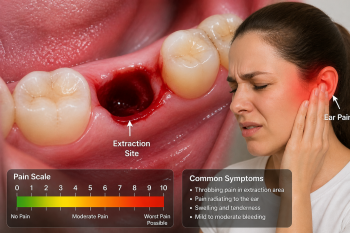
Can tooth extraction cause infection? Mild inflammation is normal, but increasing swelling, fever, or severe pain may indicate infection. Learn more about post-extraction infection warning signs in this detailed guide.
Book a consultation with our Cebu dental specialists for proper evaluation and care.
Ready to get expert guidance?
If you’re experiencing severe pain or delayed healing, book a consultation with our Cebu dental specialists to get proper evaluation and care.
Consultation or contact page .
Book a Consultation
For severe discomfort or delayed healing, book a consultation with our Cebu dental specialists today.
Looking for a dentist? Browse our Cebu dental directory to find trusted clinics near you.
Medical Review and Clinical Basis
This article is based on clinical dental guidelines and real patient recovery patterns observed after tooth extraction procedures. The information reflects common post-extraction healing stages, including normal clot formation, gum tissue repair, and signs of possible complications such as dry socket or infection.
While mild discomfort is expected after a dental extraction, worsening pain after Day 3, bad odor, exposed bone, or spreading pain may require professional evaluation. These symptoms are consistent with known post-extraction complications described in standard dental practice.
About Cebu Dental Implants
Cebu Dental Implants provides comprehensive tooth extraction, surgical procedures, and dental implant services in the Philippines. Our team evaluates post-extraction healing, manages complications such as dry socket, and advises patients on proper aftercare to prevent infection and delayed healing.
If you experience severe pain or unusual symptoms after extraction, early professional assessment is recommended to prevent further complications.
Important Medical Disclaimer
This content is for educational purposes only and does not replace professional dental diagnosis. Every patient heals differently. If symptoms worsen or do not improve within a few days, consult a licensed dentist for proper evaluation and treatment.
Author
This article was prepared by the Cebu Dental Implants content team in consultation with licensed dental professionals experienced in tooth extraction and implant procedures.
Related Clinical Cases
Patients with lower front gum inflammation may also experience tartar buildup, periodontal disease, gum abscesses, or tooth decay. Explore these related clinical case studies.


Other topics:
Other Dental Clinic