Dentures That Feel Natural, Look Beautiful.

When Dentists Leave and Patients Cannot Afford Care: The Quiet Health Crisis Behind the Philippine Economy
Language :
Topics:
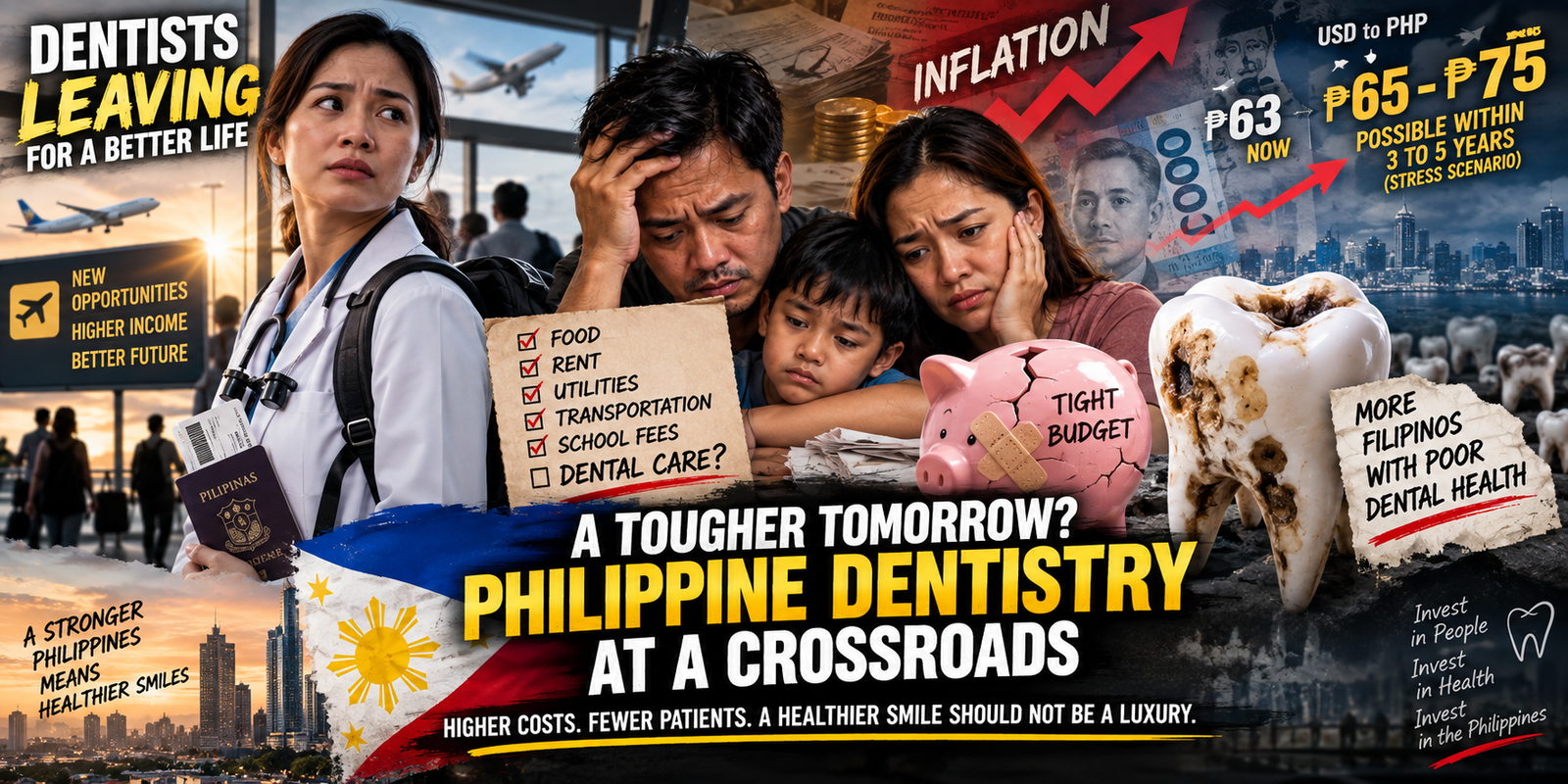
There is an economic story happening inside Philippine dental clinics that deserves more attention.
It is not simply about dentists making less money.
It is not simply about patients asking for cheaper treatment.
And it is not simply about inflation.
It is about what happens to a country's healthcare system when the people who provide care are struggling to operate their businesses while the people who need care are struggling to pay for it.
That is where the real concern begins.
"Doctor, I Need Treatment—But I Cannot Afford It."
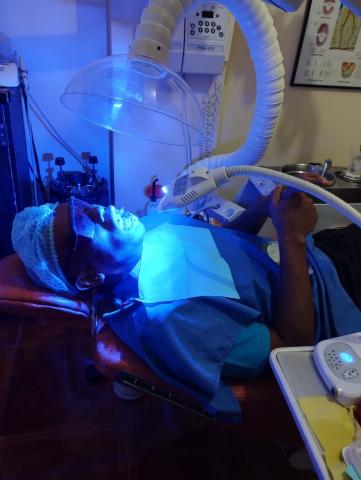
Imagine sitting in a dental chair with a painful tooth.
The dentist explains what needs to be done.
Perhaps the tooth needs a root canal.
Perhaps it needs a crown.
Perhaps several teeth need restoration.
Perhaps the patient needs dentures or dental implants.
The patient understands.
But then comes the question:
"How much will it cost?"
The dentist gives the estimate.
The patient becomes quiet.
Then comes the sentence that many healthcare professionals hear:
"Can I wait until I have the money?"
That is not a failure of the patient.
It is a reflection of household economics.
A family has to choose between dental treatment and groceries.
Between a dental procedure and rent.
Between a crown and school expenses.
Between an implant and gasoline.
Between healthcare today and keeping enough money for the rest of the month.
The Peso Has Reached a Painful Milestone
The Philippine peso recently moved to levels near ₱63 to US$1, with the peso closing at ₱62.86 per dollar on September 14, 2026, according to GMA News. The Bangko Sentral ng Pilipinas' daily exchange-rate data also shows the peso trading above ₱62 per dollar during September.
For ordinary Filipinos, the exchange rate may seem like something that belongs to financial markets.
But currency movements eventually reach everyday life.
The Philippines imports many products, materials, equipment, fuel and other goods whose prices can be influenced by international prices and exchange rates.
Dental practices are not isolated from this environment.
Dental materials.
Equipment.
Laboratory products.
Technology.
Replacement parts.
Some pharmaceutical and healthcare inputs.
Transportation.
Utilities.
All of these contribute to the cost of operating a clinic.
What If the Peso Reaches ₱65 or ₱75?
There is an important distinction here.
A future exchange rate of ₱65 or ₱75 per US dollar is not a confirmed forecast.
It would be better understood as a scenario.
At ₱65/$, the peso would be substantially weaker than it was several years ago.
At ₱75/$, the pressure could become considerably greater for businesses and consumers exposed to imported goods and foreign-currency costs.
The important question isn't whether ₱75/$ will definitely happen.
The important question is:
What would happen if the peso continued weakening while household incomes failed to keep pace with prices?
That is the scenario worth discussing.
The Economy Is Not Simply "Collapsing"
It is also important to avoid exaggerating the situation.
The Philippine economy continues to grow.
The World Bank reported in August 2026 that the Philippines had reached upper-middle-income status, describing this as the result of two decades of sustained economic growth and rising living standards. At the same time, it warned that current headwinds—including weaker investment, policy uncertainty and higher global energy prices—are affecting growth. The World Bank projected Philippine growth of 3.7% in 2026.
That creates an important distinction.
Economic growth does not automatically mean every household feels financially comfortable.
GDP can grow while families still struggle with the cost of food, transportation, housing, education and healthcare.
A country can move upward economically while some individuals still feel that their personal purchasing power is going backward.
That is the human side of economics.
The Dentist Is a Small Business Owner Too
Sometimes people forget this.
A dentist is a healthcare professional.
But a dental clinic is also a business.
The clinic has bills.
Rent.
Electricity.
Dental assistants.
Reception staff.
Laboratory expenses.
Dental materials.
Equipment.
Sterilization.
Maintenance.
Taxes.
Technology.
Marketing.
Supplies.
If patient volume declines while operating costs increase, the clinic's financial pressure becomes very real.
A dentist may want to provide affordable treatment.
But the clinic cannot operate indefinitely below its costs.
This creates a painful equation:
Patients need lower prices.
Clinics face higher costs.
Dentists need an income.
Families have limited disposable income.
There is no easy solution.
What Happens If Dentists Start Looking Overseas?
This is where the discussion becomes more serious.
A dentist who feels financially trapped in the Philippines may eventually consider opportunities elsewhere.
Perhaps another country offers higher professional income.
Perhaps the dentist wants better opportunities for their children.
Perhaps the dentist wants greater financial security.
Perhaps they simply want a better quality of life.
For an individual professional, that decision can be completely understandable.
People naturally want to improve their lives.
But there is a potential public-health question:
What happens if enough healthcare professionals decide that their future is somewhere else?
This article is not claiming that there is currently a nationwide mass departure of Filipino dentists. Reliable data would be needed to establish the scale of any such trend.
The concern is about the possible consequence of sustained economic pressure.
If healthcare professionals increasingly seek opportunities abroad, the domestic system could face additional challenges in retaining experienced professionals.
The Dangerous Combination
Imagine three trends occurring at the same time:
1. Dental operating costs increase.
2. Patients become increasingly price-sensitive.
3. Healthcare professionals become more interested in opportunities overseas.
That combination could create a difficult feedback loop.
Clinics struggle.
Patients postpone care.
Dentists look for better opportunities.
Access becomes more difficult.
And patients with limited income may wait even longer before receiving treatment.
The result could be a slow-moving oral-health problem rather than one dramatic event.
The People Who Can Least Afford It May Be Hit Hardest
A wealthy patient may be able to absorb a ₱50,000 or ₱100,000 dental bill.
A middle-income family may need to save for months.
A low-income family may simply postpone treatment.
That difference matters.
The person with the least financial flexibility may also be the person least able to absorb the consequences of delayed treatment.
A small cavity may become a larger problem.
A damaged tooth may eventually need extraction.
Missing teeth may remain unreplaced.
Gum disease may remain untreated.
Pain may become normalized.
And dental visits may happen only when a problem becomes impossible to ignore.
Dental Health Is Not Just About Appearance
There is another misconception worth challenging.
People sometimes think dentistry is primarily about having a beautiful smile.
It isn't.
Oral health affects eating, speaking, comfort and quality of life.
Serious dental infections can require urgent medical attention.
Untreated oral conditions can cause significant pain and interfere with everyday activities.
That is why affordability of dental care is not merely a cosmetic issue.
It is a health-access issue.
The Hidden Cost of Delaying Treatment
There is an economic paradox here.
A patient may postpone a ₱5,000 or ₱10,000 treatment because they cannot afford it today.
But if the condition worsens, the eventual treatment may become substantially more complicated.
The patient may then face a much larger bill.
This creates a cycle:
Cannot afford treatment → postpone treatment → condition worsens → treatment becomes more complicated → larger financial burden
For financially stressed families, prevention and early treatment can therefore be particularly important.
What Economists Are Watching
The broader economic outlook is more complicated than simply saying that the Philippines is "getting worse."
The World Bank expects growth to continue, but its latest assessment says growth has been affected by policy uncertainty, weaker investment and higher global energy prices.
The IMF's 2026 outlook also emphasizes uncertainty and downside risks in the global economy, particularly from geopolitical tensions, energy prices and financial-market conditions.
So the responsible interpretation is not:
"The Philippine economy will collapse."
Nor is it:
"Everything will be fine."
The more realistic conclusion is:
The Philippines continues to have economic growth potential, but households and businesses can still experience substantial financial pressure during periods of high costs, weak purchasing power and uncertainty.
And dentists are part of that economy.
The Human Cost Behind the Numbers
Economists talk about GDP.
Central banks talk about inflation.
Financial markets talk about exchange rates.
Businesses talk about margins.
But ordinary people experience the economy differently.
They experience it when they stand at the grocery counter.
They experience it when they pay rent.
They experience it when they fill their motorcycle or car with gasoline.
They experience it when their electricity bill arrives.
And they experience it when the dentist says:
"This is what your treatment will cost."
That is where economics becomes personal.
A Future We Should Be Careful About
The most concerning future isn't necessarily a dramatic economic collapse.
It could be something much quieter.
Patients gradually stop going to the dentist.
Dentists gradually reduce investment in their clinics.
Young dental professionals increasingly consider opportunities abroad.
Clinics become more dependent on higher-income patients.
Preventive care becomes less accessible to lower-income families.
Dental problems accumulate quietly.
And years later, the country discovers that a large portion of the population has been living with preventable oral-health problems.
That is the scenario worth preventing.
We Should Not Wait for the Economy to Become Perfect
The Philippine economy will have good years and difficult years.
Currencies will rise and fall.
Inflation will move up and down.
Businesses will expand and contract.
But people's teeth continue to need care throughout all of those cycles.
That means the dental industry, government, communities and healthcare organizations need to think about affordability before the problem becomes larger.
Preventive dentistry.
Community dental programs.
Early diagnosis.
Transparent pricing.
Appropriate treatment planning.
Patient education.
Accessible financing where appropriate.
And policies that help healthcare professionals build sustainable careers in the Philippines.
A Dentist Should Be Able to Build a Life Here
There is also a human side to the dentist's story.
A dentist spends years studying.
They invest heavily in education.
They build a clinic.
They employ people.
They serve their community.
They help patients smile, eat and live without dental pain.
It is reasonable for that professional to want a good life too.
The goal should not be to force professionals to stay.
The goal should be to create an environment where staying is a viable and attractive choice.
Because when a healthcare professional succeeds, the community can benefit as well.
The Real Question
The future of Philippine dentistry will not be determined by the peso-dollar exchange rate alone.
Nor will it be determined by inflation alone.
It will be determined by how the country responds to the intersection of:
economic growth + household purchasing power + healthcare affordability + professional retention.
A country can have economic growth and still have families who cannot afford dental care.
A country can produce excellent dentists and still lose some professionals to overseas opportunities.
And a dental clinic can have skilled professionals and modern equipment while struggling to fill its appointment book.
That is the balancing act.
Final Thought: Don't Let Dental Care Become a Luxury
Behind every statistic is a person.
Behind every dental clinic is a family trying to survive.
Behind every patient who says "I'll come back when I have the money" is a financial story we may never hear.
And behind every dentist considering an overseas opportunity is a human being trying to build a better future.
The Philippines does not need to choose between affordable dental care and dentists earning a decent living.
The long-term challenge is finding a way to support both.
Because the health of a country's teeth is connected to the health of its economy.
And if the people cannot afford to protect their teeth—and the professionals providing that care cannot afford to stay—the consequences will eventually reach far beyond the dental chair.
Related Clinical Cases
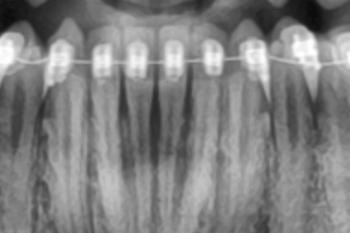
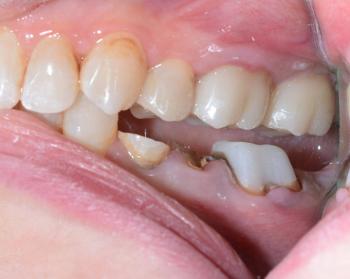
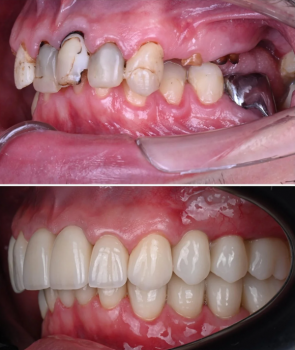
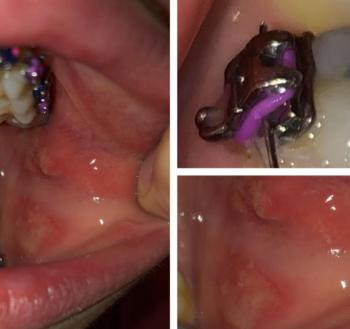
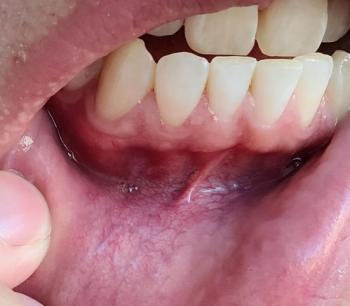
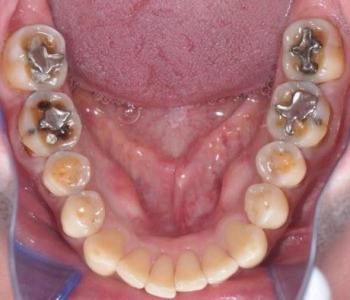
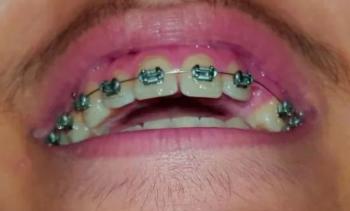
Patients with lower front gum inflammation may also experience tartar buildup, periodontal disease, gum abscesses, or tooth decay. Explore these related clinical case studies.
Other topics:
Other Dental Clinic