Your Smile, Our Passion.

Bone Loss: Jawbone Loss - A USA Dentist’s Dental Hub Review, Case Analysis, and Patient Advice
image hero:
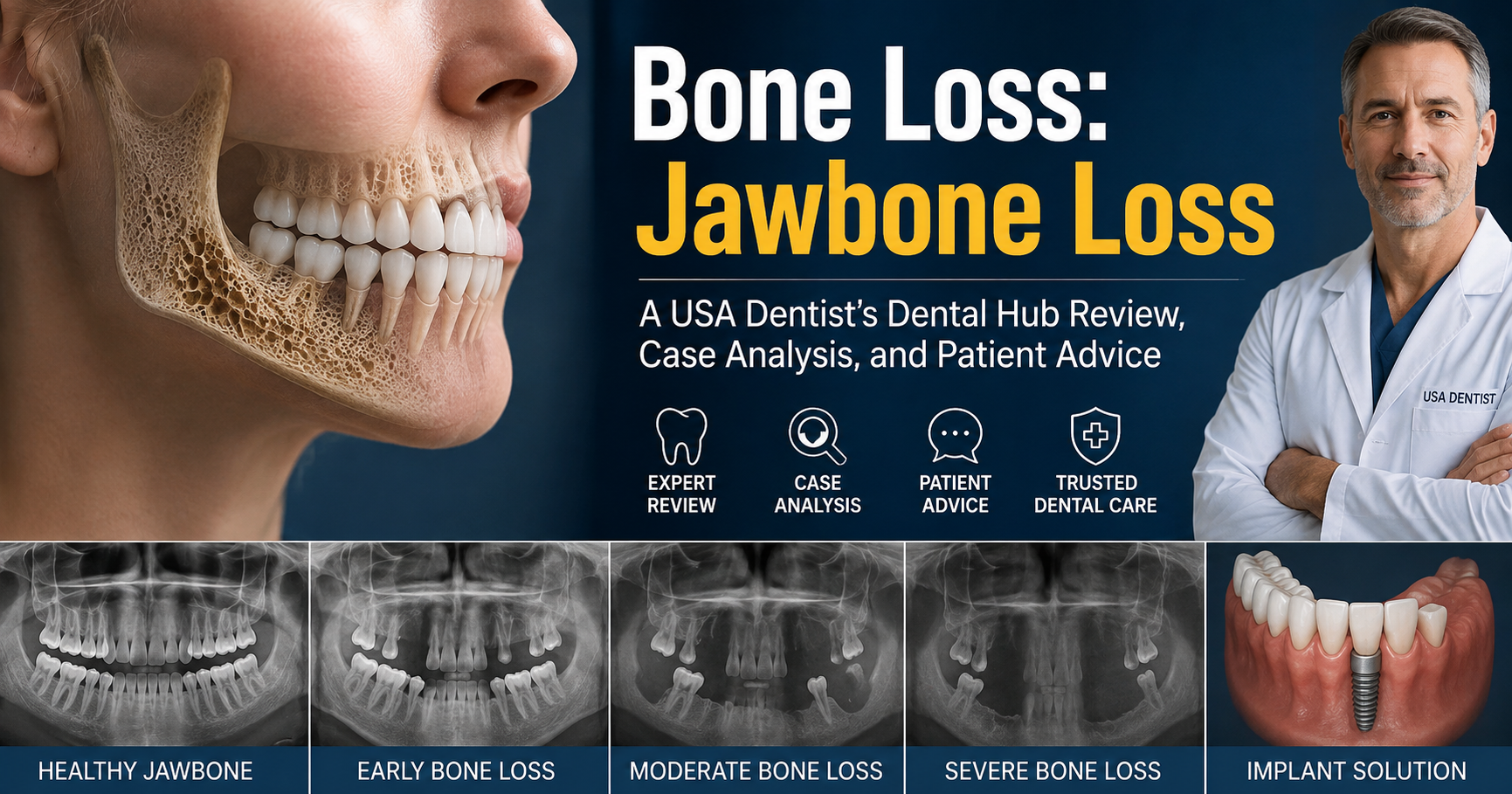
Jawbone loss, also called alveolar bone loss, is the gradual destruction or resorption of the bone that supports the teeth. It is not simply an issue of “having weak bones.” In dentistry, the location, pattern, cause, and severity of bone loss are critical because the jawbone provides the foundation for natural teeth, dentures, and dental implants.
One of the most important causes is periodontitis, an advanced form of gum disease. The American Dental Association explains that periodontal disease can destroy the gingiva, periodontal ligament, and alveolar bone and eventually lead to tooth loss.
From a U.S. dental perspective, jawbone loss should be treated as a structural dental problem that requires diagnosis, not something that should be judged only by how the gums look.
1. What Exactly Is Jawbone Loss?
The bone surrounding and supporting the roots of teeth is called the alveolar bone.
Healthy teeth are held in place through a complex supporting system:
- Gum tissue
- Periodontal ligament
- Alveolar bone
- Tooth root
- Surrounding jawbone
When chronic inflammation damages these supporting structures, the bone can gradually disappear.
The important point is that bone loss can progress before a patient experiences significant pain.
NIDCR notes that periodontal disease can spread from the gums to the bones surrounding the teeth. Advanced disease can make teeth loose and may ultimately require extraction.
2. The Most Common Cause: Periodontitis
A common progression looks like this:
Dental plaque → gingivitis → periodontal inflammation → attachment loss → alveolar bone loss → tooth mobility → tooth loss
Plaque is a bacterial biofilm that accumulates around teeth. If it is not adequately removed, it can harden into calculus.
Calculus cannot simply be brushed away at home and requires professional removal. If periodontal inflammation persists, the supporting tissues and bone can progressively deteriorate.
The American Dental Association describes the bone loss associated with periodontitis as part of the body's inflammatory response to plaque biofilm and its metabolic byproducts.
Clinical warning
A patient may say:
“My gums don't hurt, so I don't think I have bone loss.”
That assumption can be dangerous.
Periodontal disease can develop gradually, and symptoms may be subtle until substantial supporting tissue has already been damaged.
3. Other Causes of Jawbone Loss
Periodontitis is extremely important, but it is not the only possible cause.
A dental evaluation may consider:
Tooth loss
When a tooth is removed or lost, the bone that previously supported that tooth no longer receives the same functional stimulation.
Over time, the ridge can become narrower and/or shorter.
This can become particularly important when a patient eventually wants a dental implant.
Dental infection
A severe infection around a tooth can damage the surrounding supporting tissues and bone.
The dentist must determine whether the bone defect is caused primarily by periodontal disease, an endodontic infection, trauma, or another condition.
Trauma
A traumatic dental injury can damage the tooth and surrounding bone.
Advanced periodontal disease
This is one of the major causes of alveolar bone destruction and tooth loss.
Poorly fitting dentures
Long-term pressure and changes in the supporting ridge can contribute to progressive ridge resorption.
Certain medical and medication-related conditions
Some conditions affecting bone metabolism or specific medications can affect the jaw and require careful evaluation.
For example, medication-related osteonecrosis of the jaw is a distinct condition from ordinary periodontal bone loss and requires specialized diagnosis. NIDCR notes that osteonecrosis can involve exposed jawbone, swelling, drainage, loose teeth, or altered jaw sensation.
4. Case Analysis: What a Dentist Looks for
Consider a hypothetical patient:
Patient: 58-year-old adult
Complaint: “My lower front teeth feel loose.”
History: Occasional gum bleeding and bad breath
Pain: Minimal
Dental attendance: Irregular
Smoking: Current smoker
The dentist should not simply look at the loose tooth and recommend extraction.
The clinical investigation should determine:
- How deep the periodontal pockets are.
- Whether there is clinical attachment loss.
- Whether the tooth is mobile.
- Whether there is bleeding on probing.
- Whether recession is present.
- Whether bone loss is localized or generalized.
- Whether the tooth has a favorable or unfavorable prognosis.
- Whether there is an infection involving the root.
- Whether the remaining teeth are affected.
- Whether systemic or behavioral risk factors are contributing.
NIDCR describes periodontal probing and dental X-rays as important components of periodontal evaluation. X-rays can help identify bone loss associated with periodontal disease.
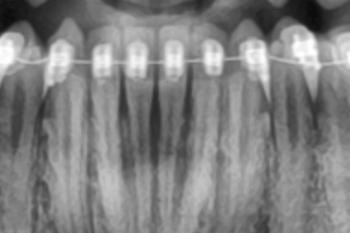
5. What Does Bone Loss Look Like on an X-Ray?
A dental X-ray may reveal that the bone level around the teeth has moved downward from where it would normally be expected.
The dentist may identify patterns such as:
- Horizontal bone loss
- Vertical/angular bone defects
- Furcation involvement
- Localized bone destruction
- Generalized bone loss
- Severe supporting bone destruction
The pattern matters.
Two patients may both be told they have “30% bone loss,” yet their treatment plans could be completely different because the location and configuration of the defects differ.
For this reason, patients should not attempt to interpret a single percentage from an X-ray without a clinical examination.
6. Symptoms That Should Get Your Attention
Possible warning signs include:
- Bleeding gums
- Persistent bad breath
- Red or swollen gums
- Gum recession
- Teeth appearing longer
- Loose teeth
- Tooth sensitivity
- Pain when chewing
- Changes in the way teeth bite together
- Food repeatedly becoming trapped around teeth
- Pus or drainage around the gums
- Increasing spaces between teeth
NIDCR specifically identifies bleeding or swollen gums, recession, loose or sensitive teeth, chewing discomfort, and persistent bad breath as possible periodontal disease symptoms.
7. Can Jawbone Loss Grow Back?
This is one of the most important questions patients ask.
The short answer:
It depends on the cause, severity, and shape of the bone defect.
Ordinary periodontal bone loss should not be assumed to spontaneously return to its original height.
However, controlling periodontal infection can stop or slow further destruction, and selected periodontal defects may be candidates for regenerative periodontal procedures.
The ADA identifies regenerative procedures as treatment options for certain cases of bone destruction, potentially involving membranes, bone graft materials, or tissue-stimulating proteins.
Therefore:
Stopping disease progression and regenerating selected defects are not the same thing.
A patient should first control the disease before focusing on reconstruction.
8. Jawbone Loss and Dental Implants
This is where bone loss becomes particularly important.
A dental implant requires sufficient bone volume and quality for predictable placement.
If a patient has lost a tooth and waited many years, the available bone may be inadequate for conventional implant placement.
Depending on the anatomy, a dental implant specialist may consider procedures such as:
- Socket preservation
- Ridge augmentation
- Guided bone regeneration
- Bone grafting
- Sinus augmentation in selected upper-jaw cases
- Alternative implant positioning
- Other prosthetic solutions
The key principle is:
The implant plan must follow the patient's actual bone anatomy.
A patient should not assume that “bone loss means I cannot get implants.”
Likewise, a patient should not assume that “I need implants, so I automatically need a bone graft.”
The decision requires clinical examination and appropriate imaging.
9. A Critical Review: Extraction Is Not Always the End of the Problem
One common misconception is:
“If the tooth is loose because of bone loss, just remove it.”
Extraction may sometimes be appropriate when a tooth has a hopeless prognosis.
But the dentist should think beyond the extraction itself.
The treatment plan should consider:
Why did the tooth fail?
If uncontrolled periodontitis caused the tooth loss, extracting one tooth does not automatically eliminate the underlying periodontal disease.
The remaining teeth may still be at risk.
The ADA emphasizes that periodontal treatment is directed toward controlling plaque biofilm and calculus and establishing an environment that can be maintained in periodontal health.
10. Treatment Strategy
Treatment depends on the diagnosis.
Stage 1: Diagnose the disease
The dentist evaluates:
- Periodontal pockets
- Attachment loss
- Tooth mobility
- Gum recession
- Bone levels
- Bite
- Infection
- Risk factors
Stage 2: Control the infection
Treatment may include professional periodontal cleaning and, when indicated, scaling and root planing.
Stage 3: Improve daily plaque control
Patients generally need an effective home-care routine.
NIDCR recommends brushing twice daily with fluoride toothpaste and regular cleaning between the teeth using floss or an appropriate interdental device.
Stage 4: Reassess
The dentist determines whether the periodontal tissues are responding adequately.
Stage 5: Advanced treatment when indicated
More advanced periodontal disease may require surgical periodontal treatment or regenerative procedures.
The ADA notes that moderate to advanced cases can require surgical access for root-surface treatment and pocket reduction, depending on the individual case.
Stage 6: Long-term maintenance
This is critical.
Periodontal disease is not something that should be considered permanently “fixed” after one deep cleaning.
Long-term professional maintenance and daily home care are essential to reduce the risk of recurrence.
11. Smoking Is a Major Risk Factor
Smoking deserves special attention in any jawbone-loss discussion.
NIDCR identifies smoking as the most significant risk factor among those listed for gum disease and notes that smoking can also make periodontal treatment less successful.
From a dental treatment perspective, smoking cessation can therefore be an important part of protecting the remaining periodontal tissues and improving treatment outcomes.
12. What Patients Should Ask Their Dentist
If you have been told that you have jawbone loss, ask:
- Where exactly is the bone loss?
- Is it localized or generalized?
- What caused it?
- Do I have periodontitis?
- What are my periodontal pocket measurements?
- Which teeth have the most severe bone loss?
- Are any teeth considered hopeless?
- Can the affected bone defect be treated or regenerated?
- Will I need periodontal surgery?
- If a tooth must be removed, will I need ridge preservation?
- Would I be a candidate for a dental implant?
- Do I need a periodontist or implant specialist?
- How frequently should I return for periodontal maintenance?
These questions can turn a vague diagnosis of “bone loss” into an actual treatment strategy.
13. Dental Hub Expert Advice
Don't wait for pain.
Bone loss caused by periodontal disease can progress without dramatic symptoms.
Don't rely on an X-ray alone.
The X-ray is important, but periodontal probing, clinical examination, medical history, tooth mobility, and other findings are necessary for a complete assessment.
Don't assume every loose tooth must be extracted.
Some teeth may be treatable depending on their periodontal and restorative prognosis.
Don't assume severe bone loss means implants are impossible.
Some patients with inadequate bone may still have reconstructive or alternative implant options.
Don't focus only on replacing the missing tooth.
The disease that caused the tooth loss must also be addressed.
Don't ignore bleeding gums.
Persistent bleeding is a reason to seek a professional periodontal evaluation rather than simply masking the symptom.
14. When to Seek Urgent Dental Evaluation
Contact a dentist promptly if you develop:
- Rapidly increasing facial or jaw swelling
- Severe dental pain
- Pus or significant drainage
- Fever with dental symptoms
- Rapidly worsening tooth mobility
- Difficulty opening the mouth
- Difficulty swallowing
- Difficulty breathing
- Significant facial swelling
Difficulty breathing or swallowing associated with dental or facial swelling can represent a potentially serious infection and requires emergency medical evaluation.
Final Dental Hub Review
Jawbone loss is not simply an aging problem.
It is often a sign that the structures supporting the teeth have been damaged by disease, tooth loss, infection, trauma, or another underlying process.
The most important clinical question is not simply:
“How much bone have I lost?”
It is:
“Why did I lose the bone, is the disease still active, and what can be done to preserve the remaining bone and teeth?”
Modern periodontal treatment can control disease, preserve teeth in appropriate cases, and sometimes regenerate selected areas of lost periodontal support. For patients who have already lost teeth, bone-preservation and bone-reconstruction strategies may also help create better conditions for future tooth replacement.
A proper diagnosis should come before treatment decisions.
Dental Hub Clinical Takeaway: If a dentist tells you that you have jawbone loss, request a complete periodontal evaluation and an explanation of the X-rays. If the condition is moderate to severe, a consultation with a periodontist may be appropriate.
This article is educational information and does not replace an examination, diagnosis, or individualized treatment plan from a licensed dentist or periodontist.
Related Clinical Cases
Patients with lower front gum inflammation may also experience tartar buildup, periodontal disease, gum abscesses, or tooth decay. Explore these related clinical case studies.


Other topics:
Other Dental Clinic
 |
 |
 |
 |