Your Smile, Perfected with Precision.

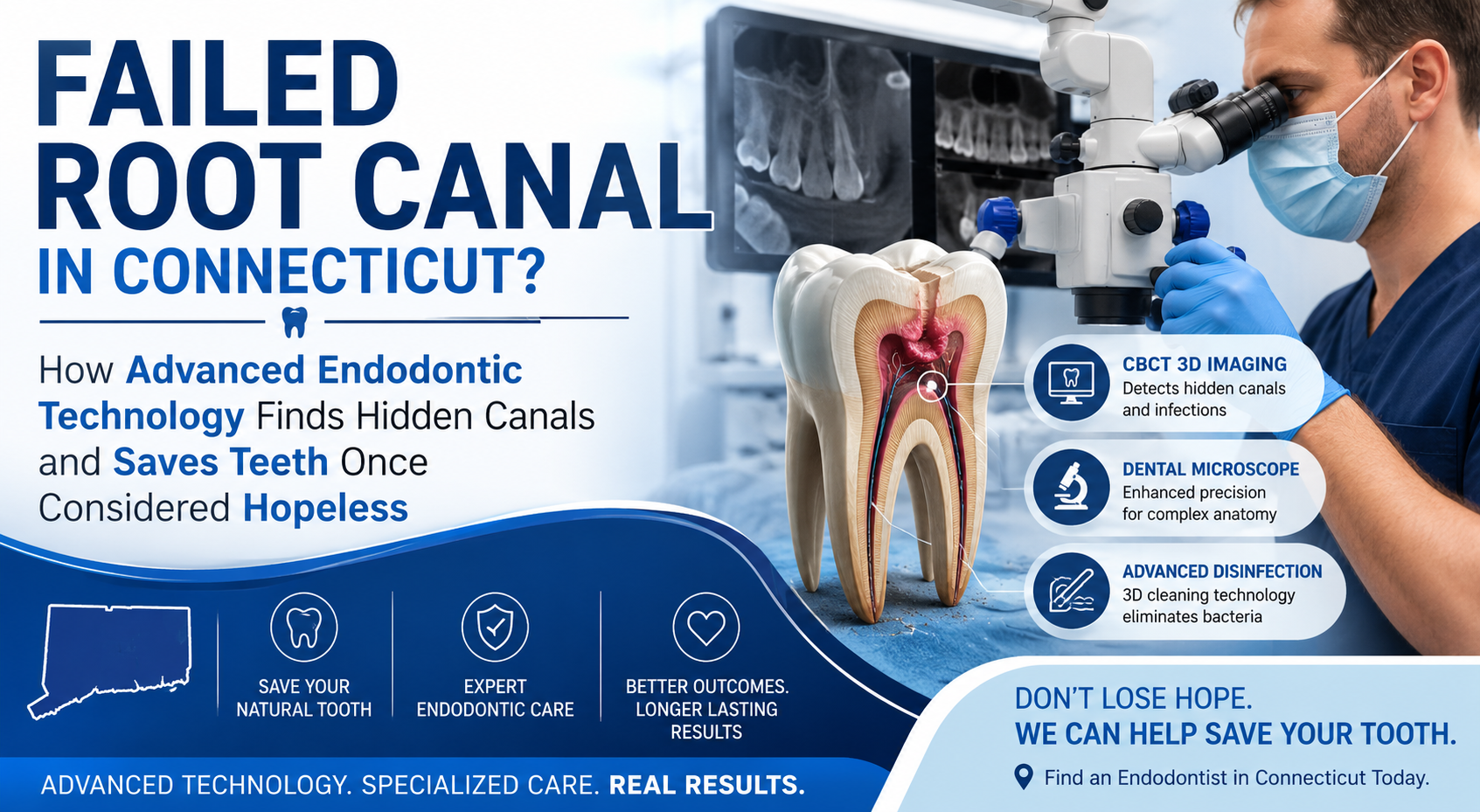
Failed Root Canal in Connecticut? How Advanced Endodontic Technology Finds Hidden Canals and Saves Teeth Once Considered Hopeless
Language :
Topics:
For many years, patients were often told that a severely infected tooth, a tooth with extensive decay, or a tooth that had failed a previous root canal treatment could not be saved. Extraction was frequently considered the only solution.
Today, that reality has changed dramatically.
Modern root canal treatment (RCT) has evolved into one of the most sophisticated and successful procedures in dentistry. Thanks to advanced imaging systems, precision microscopes, enhanced cleaning technologies, and bioactive materials, teeth once considered hopeless can now often be preserved for many years—even decades.
As an experienced USA dentist, I frequently meet patients who arrive believing their tooth is beyond repair. Some have been told extraction is inevitable. Others suffer from recurring infections, chronic pain, or failed root canal treatments performed years earlier.
In many of these cases, modern endodontic techniques reveal a different story.
The problem is often not that the tooth cannot be saved. The real issue is that hidden anatomy, untreated canals, persistent bacteria, or inadequate previous treatment prevented complete healing.
This article explores how modern endodontics is transforming tooth preservation, why advanced technology matters, and how patients in Connecticut can access specialized care when facing difficult dental situations.
Understanding Root Canal Treatment
Root canal treatment is designed to save a natural tooth when the pulp inside becomes infected or inflamed.
The dental pulp contains:
- Blood vessels
- Nerves
- Connective tissue
When bacteria enter the pulp through:
- Deep decay
- Large fillings
- Cracks
- Trauma
- Repeated dental procedures
the pulp may become irreversibly damaged.
Without treatment, infection can spread beyond the root tips and into surrounding bone.
This may cause:
- Severe tooth pain
- Swelling
- Gum abscesses
- Bone loss
- Facial infection
- Tooth loss
Root canal treatment removes infected tissue, disinfects the internal canal system, and seals the tooth to prevent future bacterial contamination.
According to Mamat and Nik Abdul Ghani (2023), successful treatment depends heavily on understanding the complexity of root canal anatomy and achieving effective cleaning throughout the entire canal system.
Why Some Teeth Seem Impossible to Save
Many challenging teeth share similar characteristics.
Extensive Infection
Some patients seek treatment only after years of symptoms.
The infection may have spread:
- Deep into bone
- Around multiple roots
- Into surrounding tissues
Traditional approaches sometimes struggled to eliminate these advanced infections completely.
Previous Failed Root Canal Treatment
A common reason for failure is that not all canals were identified and treated.
For example:
A maxillary first molar often contains:
- Three roots
- Four canals
However, some teeth possess:
- Five canals
- Six canals
- Additional accessory canals
If even one canal remains untreated, bacteria may continue multiplying inside the tooth.
Complex Anatomy
No two teeth are identical.
Some teeth contain:
- Curved canals
- Calcified canals
- Extremely narrow canals
- Branching canal systems
- Lateral canals
These anatomical variations make diagnosis and treatment significantly more difficult.
Hidden Cracks
Cracks can allow bacteria to enter deep within the tooth structure.
Many cracks are invisible without magnification and advanced imaging.
The Revolution of Modern Endodontics
The field of endodontics has undergone enormous advancements during the last two decades.
Modern treatment is no longer simply about removing infected tissue.
Today, specialists focus on:
- Preserving tooth structure
- Identifying hidden anatomy
- Eliminating bacterial biofilms
- Promoting biological healing
According to Iandolo (2023), contemporary endodontic therapy combines advanced diagnostic tools, minimally invasive techniques, and bioactive materials to improve treatment outcomes significantly.
CBCT: The Technology That Changed Everything
One of the most important developments in endodontics is Cone Beam Computed Tomography (CBCT).
Unlike traditional dental X-rays, CBCT creates a three-dimensional image of the tooth and surrounding structures.
This technology allows clinicians to examine anatomy from multiple angles.
What Traditional X-Rays Miss
Conventional radiographs are two-dimensional.
As a result:
- Roots may overlap
- Hidden canals may remain invisible
- Fractures may be difficult to detect
- Bone destruction can be underestimated
This limitation can affect treatment planning.
How CBCT Improves Diagnosis
CBCT provides:
- Three-dimensional visualization
- Accurate canal mapping
- Root curvature analysis
- Detection of hidden infections
- Identification of missed canals
- Assessment of previous treatment failures
Research by McGuigan et al. (2024) demonstrated that CBCT significantly improves endodontic access and canal location accuracy.
A Connecticut Patient Story
A patient arrived at our office after years of recurring pain.
The tooth had already undergone root canal treatment.
Traditional X-rays suggested treatment appeared acceptable.
However, CBCT imaging revealed:
- A completely untreated hidden canal
- Persistent infection surrounding the root tip
- Bone destruction around the untreated area
Without CBCT, the source of failure might never have been discovered.
After retreatment and proper disinfection, healing began successfully.
This type of case is becoming increasingly common.
The Critical Role of Dental Operating Microscopes
Modern endodontists rarely perform complex treatment without magnification.
The dental operating microscope has become one of the most valuable tools in advanced root canal therapy.
Why Magnification Matters
Some canals are smaller than a human hair.
Without magnification:
- Canal openings may be overlooked
- Calcified canals may remain hidden
- Cracks may go undetected
Microscopes provide magnification levels impossible with the naked eye.
Improved Precision
Microscopes help dentists:
- Locate hidden canals
- Preserve healthy tooth structure
- Remove previous filling materials
- Repair perforations
- Identify fractures
Iandolo (2023) emphasizes that modern magnification supports minimally invasive treatment while maximizing diagnostic accuracy.
Ultrasonic Technology and Conservative Dentistry
Ultrasonic instruments have transformed endodontic procedures.
These devices vibrate at extremely high frequencies.
Benefits include:
- Precise removal of calcifications
- Better canal access
- Reduced tooth destruction
- Improved cleaning efficiency
Instead of aggressively removing tooth structure, dentists can work conservatively while maintaining strength.
The Hidden Enemy: Bacterial Biofilms
The primary goal of root canal treatment is bacterial elimination.
However, bacteria rarely exist as isolated organisms.
They form organized communities called biofilms.
Biofilms:
- Adhere to canal walls
- Resist disinfectants
- Survive in microscopic spaces
- Cause persistent infections
This explains why simple mechanical instrumentation is often insufficient.
Why Traditional Cleaning Alone Is Not Enough
Files clean only a portion of the root canal system.
Research suggests that instruments may contact less than half of the total canal wall surface.
Numerous areas remain untouched:
- Isthmuses
- Lateral canals
- Dentinal tubules
- Canal fins
- Apical complexities
Bacteria hiding in these spaces can survive treatment.
Modern 3D Cleaning Protocols
One of the most important advances in contemporary endodontics is three-dimensional cleaning.
According to Plotino et al. (2016), advanced activation techniques dramatically improve disinfection.
Sonic Activation
Sonic systems create fluid movement within canals.
Benefits include:
- Enhanced irrigant penetration
- Better debris removal
- Improved bacterial reduction
Ultrasonic Activation
Ultrasonic irrigation creates powerful acoustic streaming.
This allows disinfectants to reach difficult anatomical areas.
Advantages include:
- Superior cleaning
- Enhanced biofilm disruption
- Better penetration into canal irregularities
Laser-Assisted Disinfection
Some specialists use laser energy to enhance root canal disinfection.
Potential benefits include:
- Deep bacterial reduction
- Improved sterilization
- Enhanced tissue healing
Laser technology continues evolving rapidly.
Understanding Hidden Canals
One of the leading causes of root canal failure is a missed canal.
Many teeth contain more canals than expected.
Examples include:
Upper First Molars
Commonly:
- Four canals
Occasionally:
- Five canals
- Six canals
Lower Molars
Often:
- Three canals
Sometimes:
- Four canals
- Five canals
Premolars
May contain:
- One canal
- Two canals
- Three canals
Anatomical variation is normal.
This complexity explains why advanced imaging and magnification are so important.
Bioceramic Sealers: The New Generation of Root Canal Materials
Root canal filling materials have improved dramatically.
Modern endodontists increasingly utilize bioceramic sealers.
According to the American Association of Endodontists (2021), these materials represent a major advancement in obturation philosophy.
Advantages of Bioceramics
Exceptional Biocompatibility
Bioceramics are well tolerated by surrounding tissues.
Dimensional Stability
Unlike some older materials, they maintain integrity over time.
Moisture Compatibility
They perform effectively in the natural moisture environment within root canals.
Bioactivity
One of their most remarkable characteristics is their ability to stimulate mineralization and healing.
This can support long-term success.
Saving Teeth That Once Required Extraction
Many teeth previously considered hopeless can now be preserved.
Examples include:
- Large periapical lesions
- Missed canal retreatments
- Calcified canals
- Complex molars
- Persistent infections
- Anatomical anomalies
Modern technology often changes the prognosis dramatically.
Why Tooth Preservation Matters
Some patients ask:
"Why not just remove the tooth?"
Natural teeth offer advantages no replacement can fully duplicate.
Benefits include:
- Natural chewing efficiency
- Bone preservation
- Better bite stability
- Natural appearance
- Reduced future treatment needs
Whenever possible, preserving the patient's own tooth remains the preferred option.
Long-Term Success Rates of Modern Root Canal Treatment
Root canal therapy remains one of the most successful procedures in dentistry.
However, success depends on several factors.
These include:
- Accurate diagnosis
- Complete disinfection
- Proper canal sealing
- Quality restoration
- Patient maintenance
Mamat and Nik Abdul Ghani (2023) emphasize that canal anatomy and effective debridement strongly influence outcomes.
Why Crowns Are Essential After Root Canal Treatment
One of the biggest mistakes patients make is delaying the final restoration.
After root canal treatment:
- Teeth become more fragile
- Existing decay may weaken structure
- Fracture risk increases
Research by Thyvalikakath et al. (2022) demonstrated that teeth restored with crowns exhibit significantly better survival compared with teeth left uncrowned.
What a Crown Does
A crown:
- Protects weakened tooth structure
- Distributes biting forces
- Reduces fracture risk
- Improves longevity
In many cases, the crown is just as important as the root canal itself.
Connecticut's Strong Endodontic Care Network
Patients in Connecticut have access to highly trained specialists and advanced treatment centers.
Endodontists
Endodontists complete additional years of specialized training focused exclusively on:
- Root canal therapy
- Retreatment
- Surgical endodontics
- Dental trauma
For complex cases, referral to an endodontist is often the best decision.
Academic Excellence
The University of Connecticut School of Dental Medicine provides specialty training programs where residents manage advanced endodontic cases under expert supervision.
These centers frequently treat challenging referrals from throughout the region.
Finding a Specialist
The American Association of Endodontists offers resources that help patients locate qualified endodontic specialists throughout Connecticut.
Signs You May Need Advanced Endodontic Evaluation
Seek professional evaluation if you experience:
- Persistent tooth pain
- Swelling near a tooth
- Recurring gum pimples
- Pain when chewing
- Previous failed root canal treatment
- Deep decay
- Dental trauma
- Persistent infection despite treatment
Advanced imaging may reveal problems not visible on standard radiographs.
The Future of Endodontics
The future of root canal treatment continues to evolve rapidly.
Emerging technologies include:
- Artificial intelligence-assisted diagnosis
- Enhanced CBCT analysis
- Regenerative endodontics
- Advanced laser systems
- Improved bioactive materials
- Digital treatment planning
These innovations will likely make tooth preservation even more predictable.
Things to remember
Modern root canal treatment has fundamentally changed the way dentists approach severely compromised teeth.
What was once considered an "impossible" case may now be highly treatable thanks to CBCT imaging, dental operating microscopes, ultrasonic technology, advanced 3D cleaning protocols, and bioactive bioceramic materials.
The key to success lies in accurate diagnosis, complete disinfection, proper restoration, and timely treatment by experienced clinicians. Hidden canals, complex anatomy, and persistent infections no longer automatically mean extraction.
For patients in Connecticut facing difficult dental problems, advanced endodontic care offers renewed hope. Whether the challenge involves a previously failed root canal, a hidden canal missed on earlier treatment, or a severe infection threatening the tooth, modern endodontics provides powerful tools capable of preserving natural teeth that would have been lost only a generation ago.
In many cases, the tooth is not impossible to save—the right technology, the right diagnosis, and the right specialist simply have to find the path to healing.
Can tooth extraction cause infection? Mild inflammation is normal, but increasing swelling, fever, or severe pain may indicate infection. Learn more about post-extraction infection warning signs in this detailed guide.
Book a consultation with our Cebu dental specialists for proper evaluation and care.
Ready to get expert guidance?
If you’re experiencing severe pain or delayed healing, book a consultation with our Cebu dental specialists to get proper evaluation and care.
Consultation or contact page .
Book a Consultation
For severe discomfort or delayed healing, book a consultation with our Cebu dental specialists today.
Looking for a dentist? Browse our Cebu dental directory to find trusted clinics near you.
Medical Review and Clinical Basis
This article is based on clinical dental guidelines and real patient recovery patterns observed after tooth extraction procedures. The information reflects common post-extraction healing stages, including normal clot formation, gum tissue repair, and signs of possible complications such as dry socket or infection.
While mild discomfort is expected after a dental extraction, worsening pain after Day 3, bad odor, exposed bone, or spreading pain may require professional evaluation. These symptoms are consistent with known post-extraction complications described in standard dental practice.
About Cebu Dental Implants
Cebu Dental Implants provides comprehensive tooth extraction, surgical procedures, and dental implant services in the Philippines. Our team evaluates post-extraction healing, manages complications such as dry socket, and advises patients on proper aftercare to prevent infection and delayed healing.
If you experience severe pain or unusual symptoms after extraction, early professional assessment is recommended to prevent further complications.
Important Medical Disclaimer
This content is for educational purposes only and does not replace professional dental diagnosis. Every patient heals differently. If symptoms worsen or do not improve within a few days, consult a licensed dentist for proper evaluation and treatment.
Author
This article was prepared by the Cebu Dental Implants content team in consultation with licensed dental professionals experienced in tooth extraction and implant procedures.
Related Clinical Cases
Patients with lower front gum inflammation may also experience tartar buildup, periodontal disease, gum abscesses, or tooth decay. Explore these related clinical case studies.